Asbestos vinyl flooring in NZ: how to check and what to do
Asbestos vinyl flooring in NZ: what WorkSafe says, how to get it tested, what you can do yourself and when you need a licence.
Key numbers
WorkSafe rules and published prices, checked 24 November 2026
- Homes most likely to have it
- Built before 2000
- No-licence limit, non-friable only (paid or landlord work)
- 10 m²
- Test: visit and first sample
- From $205
- Removal, published rates
- $40–$180/m²
- 10 m² limit
- Only if the asbestos is non-friable and stays that way, counted over the whole removal project. Vinyl with an asbestos paper backing, lifted whole, is still licensed work
- Paper backing
- Friable. Class A if it's cut, torn or otherwise disturbed; Class B conditions if lifted whole
- Small-job minimums (one Auckland firm, + GST)
- $600+ Class B under 10 m²; $3,500+ Class A under 35 m²
Checked November 2026.
Asbestos vinyl flooring is a real possibility in any New Zealand house built before 2000. Old sheet vinyl, lino and vinyl tiles may contain it, and you can’t tell by looking: the only way to know is a lab test. Until then, leave it alone. Intact flooring that nobody disturbs is a lower risk than flooring being ripped up. Who is allowed to remove it, and roughly what that costs, depends on three things: whether the asbestos is in the vinyl or in a paper backing underneath, whether it can come up in one piece, and how much has to come up.
Do this now
- Don’t touch it. WorkSafe: “If you find asbestos, or suspect something might be asbestos, do not disturb it in any way.” No scraping or cutting a bit off to check.
- If it’s already been disturbed, stay out. “Do not re-enter the area where asbestos has been disturbed until you have been told it is safe.”
- No broom, no household vacuum. WorkSafe’s April 2026 guidance for tradespeople says “Never use domestic vacuum cleaners to clean up asbestos dust” and “Do not use a broom to sweep up waste.”
- Get it tested by a professional. WorkSafe says sampling “should only be done by a reputable contractor”.
- Tell your installer or builder about it before they start, including whether it’s been tested. WorkSafe tells tradespeople to ask the owner what they know about asbestos before starting work.
- Landlords: WorkSafe says you must identify the asbestos if work could expose anyone to it. Test first.
In short: test it (from about $205) and tell your installer. If it’s positive and the floor has to come up, get quotes from licensed removalists.
Already lifted some, or it’s crumbling: what to do now
Follow the first two steps above, then:
- Work clothes: keep them out of the washing machine. WorkSafe: “You should not try to wash asbestos fibres out of clothing using a domestic washing machine.”
- Who to call: WorkSafe says to contact “a reputable asbestos contractor or your local health protection officer”. Its homeowner page also points to the National Public Health Service.
- Next: get the floor tested before anything else happens to it.
Which old floors can contain asbestos: vinyl tiles, sheet vinyl and lino
WorkSafe’s guidance for building owners covers both tiles and sheet flooring:
| Floor | What WorkSafe says |
|---|---|
| Vinyl floor tiles | “Asbestos can sometimes be found in vinyl floor tiles and in the adhesive used under the tiles.” |
| Sheet vinyl and lino | “Asbestos paper was used in the backing of vinyl and linoleum floor coverings. It can also be found in the adhesive used under vinyl and linoleum sheets.” |
In NZ, old sheet vinyl is often called “lino”. A 2015 report for the Royal Society of New Zealand and the Prime Minister’s Chief Science Advisor describes “vinyl sheet floor coverings (‘lino’) with a chrysotile paper backing” (chrysotile is a type of asbestos). WorkSafe’s surveyor guidelines say vinyl tiles “typically were 5–7% chrysotile”, but “Paper backing can be 100% chrysotile”, and old underlays can contain asbestos too.
Which homes have it: what years asbestos was used in flooring
WorkSafe’s page on where asbestos can be found says: “If your building or workplace was built before 1 January 2000, it probably contains some asbestos materials.” Its diagram of a typical house includes vinyl flooring. After that date the risk is “lower”, not nil. Most of it went in much earlier: Health NZ says asbestos “was mainly imported and used before the 1980s”. It isn’t only the original floor, either. WorkSafe says “Any building built or renovated before 2000 could contain asbestos”, so a 1990s kitchen renovation counts, and so does a 1970s floor hiding under newer carpet.
How to tell if vinyl contains asbestos: not by looking
WorkSafe’s 2016 code of practice is blunt: “It is impossible to tell if material contains asbestos simply by looking at it, unless it is marked to indicate the presence of asbestos.” Its homeowner page agrees: “The only way to confirm that something is asbestos is to test a sample of it.”
If an edge has already lifted and you can see a paper layer under old sheet vinyl, take note. One Auckland removalist’s FAQ says “A flaky paper backing on old vinyl is a very strong indicator of asbestos.” It still isn’t proof.
Asbestos paper backing on vinyl: why it matters more than the vinyl
Friable asbestos is “in a powder form or able to be crumbled, pulverised, or reduced to a powder by hand pressure when dry”. WorkSafe’s April 2026 removal guidelines class asbestos in the vinyl itself as “Non-friable” and an asbestos paper backing as “Friable”. WorkSafe’s surveyor guidelines explain why that matters: “Fibre release is unlikely under normal use if it remains in good condition. Fibre may be released when material is cut, and there may be substantial release where flooring residue, particularly paper backing, is power-sanded.”
Friable asbestos normally needs a removalist with a Class A licence, the higher of WorkSafe’s two removal licences. Vinyl with asbestos in it but no asbestos backing can be a simpler job, as long as it doesn’t have to be cut or torn to get it out (see the 10 m² section below).
Asbestos testing in NZ: who does it and what it costs
WorkSafe doesn’t license surveyors (it licenses removalists and assessors), but says a reputable contractor, “for example, an asbestos surveyor experienced in identifying asbestos material”, can confirm whether asbestos is present and assess the risk. Expect a written report, and ask which lab they use: it should be accredited by International Accreditation New Zealand (IANZ) or another regime WorkSafe recognises.
What asbestos testing costs
From providers’ own price pages, checked 24 November 2026 (no official price data exists):
| Provider | Visit and first sample | Each extra sample |
|---|---|---|
| Fibresafe (incl. GST) | $205 | $60 |
| Asbestos Safe Consultancy (+ GST) | From $220 | Around $75 |
| Hazmat (+ GST) | $215 | $130 |
| Healthy Homes NZ (+ GST) | $249 call-out, plus $89 a sample and travel | $89 |
At three of the four, a visit and first sample costs about $205–$220 (GST included at Fibresafe, added at the other two). Healthy Homes NZ charges call-out and travel separately.
Lab-only analysis is $60 a sample at Fibresafe and $80.50 at Fibres.co.nz (both including GST), and DIY kits are sold from “as little as $115” (Property Risk NZ). But cutting a sample out disturbs the material, which is why WorkSafe wants a reputable contractor to do it.
Can you lay new flooring over asbestos vinyl?
Sometimes. WorkSafe’s guidance for tradespeople lists “Putting new flooring over existing asbestos-containing flooring” as asbestos-related work, so the installer has to decide whether and how it can be done safely. WorkSafe doesn’t say covering is always acceptable: “In some cases, it may be safer and more cost-effective to have the asbestos removed first, especially if it is friable asbestos.”
Ask the installer how they’ll avoid disturbing the old floor (will anything need grinding or cutting?), and keep the test result for whoever lifts the floor next. Our vinyl cost guide covers when you can lay over the old floor for ordinary vinyl and hybrid.
Can I remove asbestos myself in NZ?
Short answer: an owner-occupier working on their own home sits outside the asbestos rules, according to WorkSafe’s 2016 code of practice. But WorkSafe strongly recommends getting advice from a reputable asbestos contractor before you remove or work on asbestos. If you pay anyone to do the work, or you’re a landlord, the rules apply.
Landlords are PCBUs (the law’s term for a business, or a landlord, with legal health and safety duties), so the exemption doesn’t cover them. And paying anyone, even a mate for the day, turns your home into a workplace for the duration of the work. WorkSafe’s exact wording is in the Methodology below.
We don’t publish removal steps; WorkSafe’s non-friable asbestos removal info sheets set out the method.
Disposing of asbestos waste
WorkSafe says “Asbestos waste needs to be disposed of at an authorised disposal site.” If you use a contractor, they handle this. If not, ask your council which tip takes it before you start (Auckland Council says “You cannot take asbestos to transfer stations”). WorkSafe also says: “Never attempt to burn asbestos material or dump asbestos waste in normal council waste bins.”
The 10 m² rule: why it often doesn’t apply to sheet vinyl
This workplace rule (regulation 56 of the Health and Safety at Work (Asbestos) Regulations 2016) applies to any job you pay for, and to landlords. WorkSafe: “Up to 10m² of non-friable asbestos can be removed without a licence.” You can’t get around it “by dividing a large area into sectors of 10m² or less”, and “If the removal includes any amount of friable asbestos, it must be carried out by a removalist with a Class A licence.”
For vinyl with an asbestos backing, WorkSafe’s April 2026 guidelines on asbestos removal (table 3) set out two cases:
- Backing cut, torn, separated from the vinyl or otherwise disturbed to get it out: Class A conditions, whatever the size.
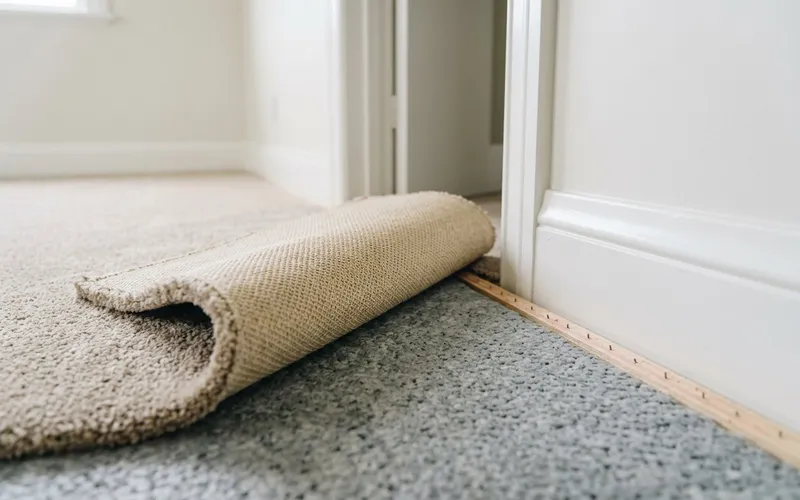
- Backing lifted whole, undisturbed: can be treated as non-friable, under Class B conditions, so it’s still licensed work. WorkSafe says this “will typically be limited to small rooms as the piece will need to fit through the door opening”.
The same table covers sheet vinyl with asbestos in the vinyl itself: it’s non-friable, but if it’s cut or torn to get it out, or leftover asbestos adhesive needs power tools to remove, it must be treated as friable, under Class A conditions.
So on a paid job, staying at 10 m² or under only helps if the asbestos is non-friable and stays that way.
When you need a licensed removalist: Class A or Class B
WorkSafe’s licensing overview sets out what each licence covers (ACM is asbestos-containing material):
| Licence | What it covers |
|---|---|
| Class A | “Any type or quantity of asbestos or asbestos-containing material, including: any amount of friable asbestos or ACM…” |
| Class B | “Any amount of non-friable asbestos or ACM.” |
Check any removalist on WorkSafe’s licence holder register, or email asbestos@worksafe.govt.nz.
- Before work starts: the removalist should assess the job “using the surveyor report” and prepare an asbestos removal control plan (ARCP). Ask to see it.
- When it’s finished: nobody goes back into the work area until a clearance certificate is issued after an independent inspection. For Class A work that’s a licensed asbestos assessor, who also monitors the air during removal; for Class B, “an independent competent person”. At a home, the removalist must arrange it. Keep the certificate.
Asbestos removal cost in NZ: what published prices show
Short answer: one renovation firm’s indicative figures put a one-room vinyl job at about $1,500–$4,000, and more for some kitchens. Add testing (from about $205) and clearance, which one cost guide puts at $300–$700 plus GST for the certificate.
No official source publishes these prices, so the figures below come from removalists, a renovation firm and a cost guide. Some include GST, some don’t, and some don’t say.
| Source (page date) | What’s priced | Price |
|---|---|---|
| Revolve Asbestos Solutions (undated, GST not stated) | Asbestos vinyl flooring removal | $40–$120/m² |
| CARE, Auckland (checked Nov 2026, + GST) | Class B, all work | $60/m² |
| CARE, Auckland (checked Nov 2026, + GST) | Class A (ceilings and vinyl) | $100/m² |
| Hazard Pro Removals, Auckland (undated, GST not stated) | Floor removal | From $130–$180/m² |
Small jobs are priced as a job, not by area:
| Source | What’s priced | Price |
|---|---|---|
| Tradie Tools (Jun 2026, ex GST) | Class B removal, up to 10 m² | $800–$2,500 |
| Tradie Tools (Jun 2026, ex GST) | Class A friable removal | $3,000–$15,000+ |
| Tradie Tools (Jun 2026, ex GST) | Clearance certificate | $300–$700 |
| Add Value Renovations (Oct 2026, GST not stated) | Vinyl, one room | Bathroom $1,500–$4,000; kitchen $1,500–$4,000+ |
| CARE, Auckland (checked Nov 2026, + GST) | Minimum, Class B under 10 m² | $600+ |
| CARE, Auckland (checked Nov 2026, + GST) | Minimum, Class A under 35 m² | $3,500+ |
Add Value Renovations calls its figures “indicative NZ market allowances, not quotes”. Per-m² rates run from about $40 to $180, and much of the spread comes down to licence class and method: CARE lists $100/m² for Class A work against $60/m² for Class B. For comparison, one Auckland firm quotes about $18–$26/m² to uplift ordinary vinyl or lino.
Get the test result, then ask licensed removalists to quote against the surveyor’s report, and to state the class of work and whether disposal and clearance are included.
Tenants and landlords: who is responsible?
Landlords carry the duty. WorkSafe says that where work could expose workers or tenants to asbestos fibres, residential landlords must “identify the asbestos in their home or on their property, and prepare an asbestos management plan for work that has a risk of exposure to asbestos.”
If you’re a landlord:
- Test before any work on old flooring.
- Don’t rely on the DIY exemption. It’s for owner-occupiers, and landlords are PCBUs.
- Use a licensed removalist wherever the job needs one: any friable asbestos (including an asbestos paper backing, even if it’s lifted in one piece), or more than 10 m² of non-friable.
- Keep the paperwork: the surveyor’s report, your asbestos management plan and the clearance certificate.
If you rent, don’t lift, sand or drill old flooring. If a floor is damaged or crumbling, tell your landlord in writing and stay out of the area.
What to tell your flooring installer or builder
Tell them early when the house was built and whether the old floor has been tested, and give them any surveyor’s report. WorkSafe tells tradespeople to ask, because “Residential owner-occupiers (this excludes landlords) are not required to have an AMP and are unlikely to have one” (an asbestos management plan). If they’re lifting it, ask who does the removal and which licence class the job needs.
Most of the Health and Safety at Work Amendment Act 2026 comes into force on 1 April 2027. From then, asbestos will be listed in the Act’s new Schedule 1A as a critical risk, which small businesses (fewer than 20 workers) still have to manage. So the installer or builder you hire keeps its asbestos duties. Our article on what WorkSafe actually requires on flooring sites covers the trade side, and what to expect from a flooring installation covers surprises found at the prep stage.
Methodology and sources
Checked 24 Nov 202638 sources
Checked on 24 November 2026. Safety advice and rules are quoted from WorkSafe guidance and the Health and Safety at Work (Asbestos) Regulations 2016 (regulations 3, 41, 42, 54 and 56) on legislation.govt.nz. The meaning of “lino” comes from a 2015 report for the Royal Society of New Zealand and the Prime Minister’s Chief Science Advisor, used as background only. Ranges compiled from published NZ removalist, tester and cost-guide pricing, checked on 24 November 2026. Sources are listed below. No government or independent source publishes asbestos testing or asbestos vinyl removal prices, Underfoot hasn’t collected quotes, and figures mix GST-inclusive and GST-exclusive prices as shown. Naming a provider isn’t a recommendation. This is general information, not legal advice.
The owner-occupier DIY point comes from WorkSafe’s 2016 approved code of practice (section 1.6.1), which WorkSafe kept in force when it published its April 2026 guidance; WorkSafe’s current homeowner page doesn’t restate it. The code says: “The Act, Regulations and the code do not apply to home occupants who conduct ‘do-it-yourself’ (DIY) work on their own homes.” In the same passage, WorkSafe recommends that trained, experienced businesses do the work “because of the health risks involved”, and notes: “Landlords are PCBUs and must comply with the Act and Regulations.” On paid work, WorkSafe’s homeowner page says: “If you pay someone to undertake work on asbestos in your home or on your property, it becomes a ‘workplace’ for the duration of the work.” The 1 April 2027 changes are to business duties, and WorkSafe’s view is that an occupier working on their own home isn’t a business (PCBU) under the Act.
Where asbestos is found, and when it was used (6)
- WorkSafe: where asbestos can be found
- WorkSafe: managing asbestos in your building or workplace, for PCBUs
- WorkSafe: conducting asbestos surveys, good practice guidelines (PDF)
- WorkSafe: asbestos in Aotearoa New Zealand
- Health NZ: asbestos and your health
- Royal Society of New Zealand and Office of the Prime Minister’s Chief Science Advisor: asbestos exposure in New Zealand (2015, PDF)
Homeowner advice, testing and disposal (3)
Rules, licences and removal (13)
- NZ Legislation: Health and Safety at Work (Asbestos) Regulations 2016
- WorkSafe: approved code of practice, management and removal of asbestos (2016)
- WorkSafe: management and removal of asbestos (code page, with April 2026 summary of changes)
- WorkSafe: asbestos guide a first for New Zealand (2016 news release)
- WorkSafe: asbestos removal, good practice guidelines (April 2026)
- WorkSafe: non-friable asbestos removal info sheets
- WorkSafe: removing asbestos-containing floor tiles and mastic (no paper backing)
- WorkSafe: removing asbestos-containing floor tiles and mastic, no paper backing (PDF)
- WorkSafe: asbestos licensing overview
- WorkSafe: asbestos licence holder register
- WorkSafe: interpretive guidelines, Health and Safety at Work (Asbestos) Regulations 2016
- WorkSafe: working with or near asbestos, information for tradespeople
- WorkSafe: working with or near asbestos, guidance for tradespeople who do asbestos-related work (April 2026, PDF)
The 1 April 2027 law change (3)
Testing prices (provider pages) (7)
Removal and uplift prices (provider and cost-guide pages) (6)
Once the old floor is sorted, our vinyl and hybrid flooring cost guide covers what the new one will cost. If you’re a flooring installer, see the trade-side WorkSafe duties for flooring sites.