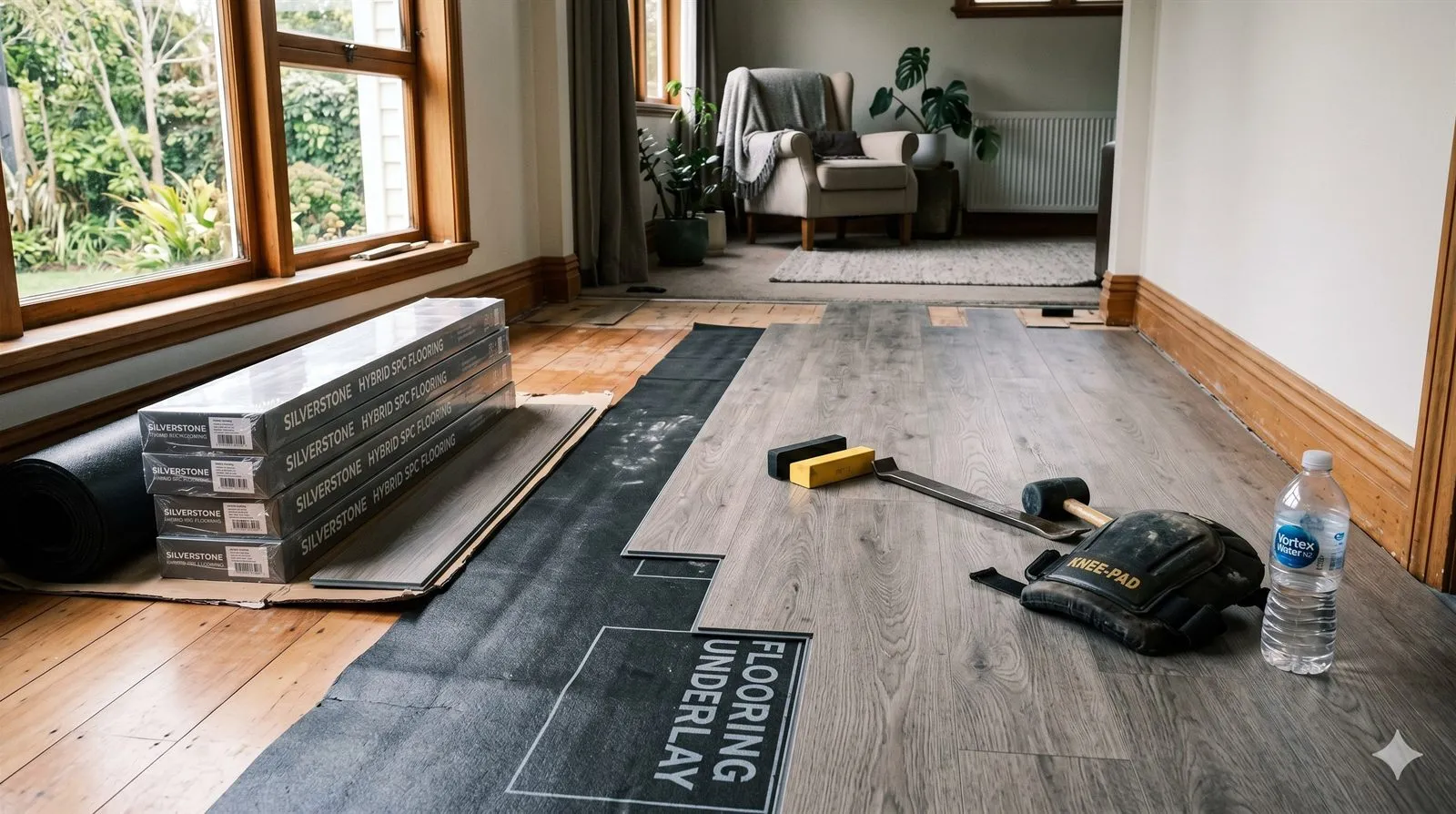
If you’ve never had flooring installed before, the process is more involved than retailers make it sound. This piece walks through what actually happens — from the first quote to the day after install — so you know what to expect and where things go wrong.
The full process, end to end
A typical residential flooring installation in NZ has eight stages:
- Initial inquiry and rough quote
- Site visit and measurement
- Detailed quote
- Decision and deposit
- Material order and lead time
- Subfloor prep and pre-install work
- Installation
- Snagging and final payment
Each stage has its own pitfalls. Here’s what happens at each.
1. Initial inquiry (first contact, day 1)
You contact a retailer or installer with rough information — number of rooms, square metreage, product interest. They’ll either give you a “from $X” rough quote on the phone, or invite you in to discuss product options.
What to do: Get rough numbers from at least three sources. Don’t commit to anything. Ignore “from $X” pricing — it’s almost always supply-only and misleading.
What might go wrong: A retailer or installer who refuses to give any rough indication is hiding something or setting up a high-pressure showroom visit. A reasonable installer will tell you “for vinyl plank in your area, expect $90–$140 per m² supplied and installed.”
2. Site visit and measurement (week 1–2)
A real installer needs to see your home before quoting. They’ll measure rooms, inspect existing flooring, check the subfloor, and discuss product options on-site. A good site visit takes 30–60 minutes.
What they’ll look at:
- Floor area (laser measure or tape)
- Existing flooring type and condition
- Subfloor (concrete, particle board, timber)
- Moisture (visual check, sometimes a moisture meter)
- Level changes, transitions, doorways
- Skirting condition
- Furniture and access logistics
What to do: Be there for the site visit. Ask what they’re checking. Ask whether they think your subfloor needs prep work and what that might cost. Ask if there are any concerns (moisture, asbestos in old vinyl, etc.).
What might go wrong: An installer who doesn’t inspect the subfloor is going to discover problems on installation day, when changes cost more. Walk away if they won’t do a proper site visit.
3. Detailed quote (week 2–3)
You receive a written, itemised quote. As covered in our cost guide, it should include:
- Product supply (with specific product code/name)
- Underlay or moisture barrier
- Subfloor prep (if needed)
- Uplift and disposal of existing flooring
- Furniture moving (or note if not included)
- Installation labour
- Trim, transitions, skirtings (if needed)
- Estimated timeframe
- Total
What to do: Compare quotes apples-to-apples on the same scope. Ask about anything that’s not on the quote. Push back on vague items.
What might go wrong: Quotes that lump everything into one “supply and install” line. Installers who avoid putting timeframes in writing.
4. Decision and deposit (week 3–4)
You commit to an installer. A reasonable deposit is 25–35% to cover material order and a slot on their schedule. Some retailers demand 60–75%; this is unnecessary and bad for you. Push back.
What to get in writing:
- Final price
- Detailed scope of work
- Timeframe (start date, expected duration)
- What happens if there are unforeseen issues
- Variation policy (price changes during install)
- Insurance details (their public liability)
- Warranty terms
- Payment schedule
What might go wrong: Verbal agreements that get fuzzy when problems arise. Insist on written confirmation.
5. Material order and lead time (weeks 4–8)
Lead time varies wildly by product:
- In-stock synthetic carpet: 1–2 weeks from order to install
- Wool carpet: 4–8 weeks (often imported)
- Common vinyl plank: 2–3 weeks
- Specialty hybrid/SPC ranges: 4–6 weeks
- Engineered hardwood: 6–12 weeks (specialty product, often custom-finished)
- Solid hardwood: 8–16 weeks for premium ranges
This is where projects slip. Materials don’t arrive when expected; the installer’s schedule shifts; suddenly your “install in May” becomes “install in late June.”
What to do: Ask about lead time before you commit. Build buffer into your timeline. Don’t book your installer for a hard deadline you can’t move.
What might go wrong: Imported product delays from international supply chain issues. Particular wool carpet ranges go out of production and require switching products mid-project.
6. Subfloor prep and pre-install work (1–2 days before install)
The day or two before installation, your installer should:
- Confirm the install date and arrival time
- Ask you to clear the rooms (or arrive to do it themselves if that’s in the quote)
- Acclimatise materials (timber and engineered timber need 48–72 hours in the room before laying)
The pre-install day is when subfloor prep happens — uplifting old flooring, levelling, moisture barrier, etc. This work is invisible in the finished floor but determines whether the installation lasts.
What to do: Be home for the prep day. If they discover an issue (rotted boards, moisture, asbestos), you want to be there for the conversation.
What might go wrong: Surprise discoveries that change scope and price. Get any variations in writing before they proceed with extra work.
7. Installation (1–4 days, depending on size and product)
Realistic on-site times for a typical residential install:
- Carpet, 100m² home: 1–2 days
- Vinyl plank or hybrid, 100m²: 1–2 days
- Engineered hardwood (click-lock), 100m²: 2–3 days
- Engineered hardwood (glue-down), 100m²: 3–4 days
- Solid hardwood with sand and finish: 5–10 days (sanding takes time, finish takes time to cure)
What happens during install:
- Existing flooring removed (if not done at prep stage)
- Underlay or moisture barrier laid
- New flooring laid, cut, joined
- Trim and transitions fitted
- Skirtings reinstated or replaced
- Site cleaned
What to do: Be home for at least the first hour to confirm scope, and be reachable for questions during the day. Don’t move furniture back the same day — let everything settle.
What might go wrong: Material defects discovered mid-install (some boards damaged in shipping). Installation that doesn’t match the agreed scope. Damage to walls, skirting, or doors during install — happens with even good installers occasionally; should be repaired before final payment.
8. Snagging and final payment (day after install)
The day after installation, walk through the work carefully. Look for:
- Cuts that don’t sit flush against walls
- Visible joins (carpet seams, plank transitions)
- Damaged skirting or door frames
- Squeaks underfoot in hard flooring
- Loose or unsecured edges
- Trim and transition strips fitted properly
- Cleanup completion
What to do: Make a snagging list. Discuss with the installer. They should remediate any reasonable issues before you make the final payment.
Reasonable to ask for fixes: Visible seams that should be hidden, damaged skirting, gaps at trim, loose edges, planks that aren’t seated.
Not reasonable to ask for fixes: Subfloor levelling outside what was quoted, perfect colour match between batches (slight variation is normal), absolute silence underfoot in 100-year-old houses.
What to do about issues: Photograph them, communicate in writing (text or email), give the installer reasonable time to remediate (typically 1–2 weeks). Withhold final payment until issues are resolved.
How long the whole process takes
From first call to floor laid:
- Best case (in-stock product, quick installer): 3–4 weeks
- Typical: 6–10 weeks
- Specialty product or busy installer: 12+ weeks
If you’re trying to align with another renovation milestone (paint finishing, kitchen install, moving in), build at least 8 weeks of buffer between when you decide and when you need the floor laid.
What surprises homeowners most
A few recurring shocks from real cases:
Subfloor surprises that change the price. Discoveries during prep — rotten boards, asbestos, moisture, cracked concrete — that add cost. This is often legitimate but can be exploited by less honest installers. Get a second opinion if a “discovered” issue dramatically changes the quote.
Material variations between samples and the laid floor. A 50mm sample looks different from 100m² of the same product in your actual lighting. Ask to see a larger swatch in your home before committing — most installers will provide one.
Furniture damage during moving. Even careful installers occasionally scrape walls or damage furniture. Document with photos before and after. This is rare but worth being aware of.
Floor smell for a few days. New vinyl and hybrid flooring off-gas mildly for the first 1–2 weeks. Open windows, air the rooms. The smell fades.
Visible expansion gaps. Floating floors (vinyl, hybrid, laminate) need 10mm gaps at perimeters to expand. A good installer hides these with skirting or scotia. Sometimes they’re visible at door frames or where the floor meets fixed obstacles.
What to do next
If you’re getting close to commissioning a flooring install:
- Get itemised quotes from at least three installers
- Walk through this list with your chosen installer to confirm everything is covered
- Build buffer time into your project — at least 8 weeks from decision to laid floor
- Stay home for the prep day to handle any surprises in person
We’ve covered costs and product comparison. Next on our list is how to find a good flooring installer in Auckland — vetting, references, what to look for. Subscribe at underfoot.co.nz/newsletter to be notified when it goes up.