How much does vinyl or hybrid flooring cost installed in NZ in 2026?
Vinyl flooring installation cost NZ 2026: sheet vinyl $35–$70/m², vinyl plank $60–$100, hybrid $80–$120 installed, plus prep, underlay and trims.
Prices checked October 2026.
In New Zealand in 2026, vinyl flooring installation costs about $35–$70/m² for sheet vinyl, supplied and installed. Mid-range vinyl plank runs $60–$100/m² and mid-range hybrid (SPC) $80–$120/m², so hybrid usually costs a little more than vinyl plank. What you actually pay depends mostly on the extras that go on top: subfloor prep, lifting the old floor, acoustic underlay if you’re in an apartment, and trims.
Floor not flat? Skip to subfloor prep and the cost to level a floor.
In an apartment? Skip to apartments: noise rules, approval and acoustic underlay.
This guide covers vinyl and hybrid only. For carpet, laminate and timber, see our NZ flooring cost guide for every floor type.
Vinyl and hybrid flooring cost per m²: the short answer
| Floor | Mid-range (supplied and installed, per m²) | Premium (per m²) |
|---|---|---|
| Sheet vinyl | $35–$70 | n/a |
| Vinyl plank (LVP) | $60–$100 | $100–$140 |
| Hybrid / SPC | $80–$120 | $130–$180 |
In the mid-range, hybrid sits about $20/m² above vinyl plank at both ends ($80 against $60, $120 against $100). Sources differ on GST, so check whether each quote includes it.
What the price includes: product and the labour cost to install vinyl flooring
Labour is roughly $20–$40/m² for vinyl, according to one national guide (Tradie Tools, GST inclusive), though one Auckland guide (Trade Directory, GST may be extra) says up to $70 for plank or laminate. Product alone is roughly $20–$80/m² for sheet vinyl and $40–$120 for plank or hybrid: the Tradie Tools calculator’s 2025 table gives $20–$40 for sheet and $45–$120 for hybrid or LVP, and Ecodure (March 2026) gives $30–$80 for sheet and $40–$100 for LVP. Neither states whether GST is included.
We found no NZ guide that publishes a labour rate for hybrid on its own. So budget from the installed ranges.
Sheet vinyl, vinyl plank and hybrid: what you’re paying for
Sheet vinyl comes off a roll and is the cheapest of the three. Ecodure’s vinyl guide says it needs “a very smooth, well-prepared subfloor”.
Plenty of people still search for “lino”, but we found no sourced price for true linoleum, so these figures are for sheet vinyl. Wondering what it costs to lay lino in a 30 m² space in NZ? At 30 m² × $35–$70, that’s $1,050–$2,100, before prep and removal of the old floor.
Vinyl plank (LVP, luxury vinyl plank) is either click-lock, which floats on the subfloor, or glue-down, which needs a smooth, dry, level subfloor.
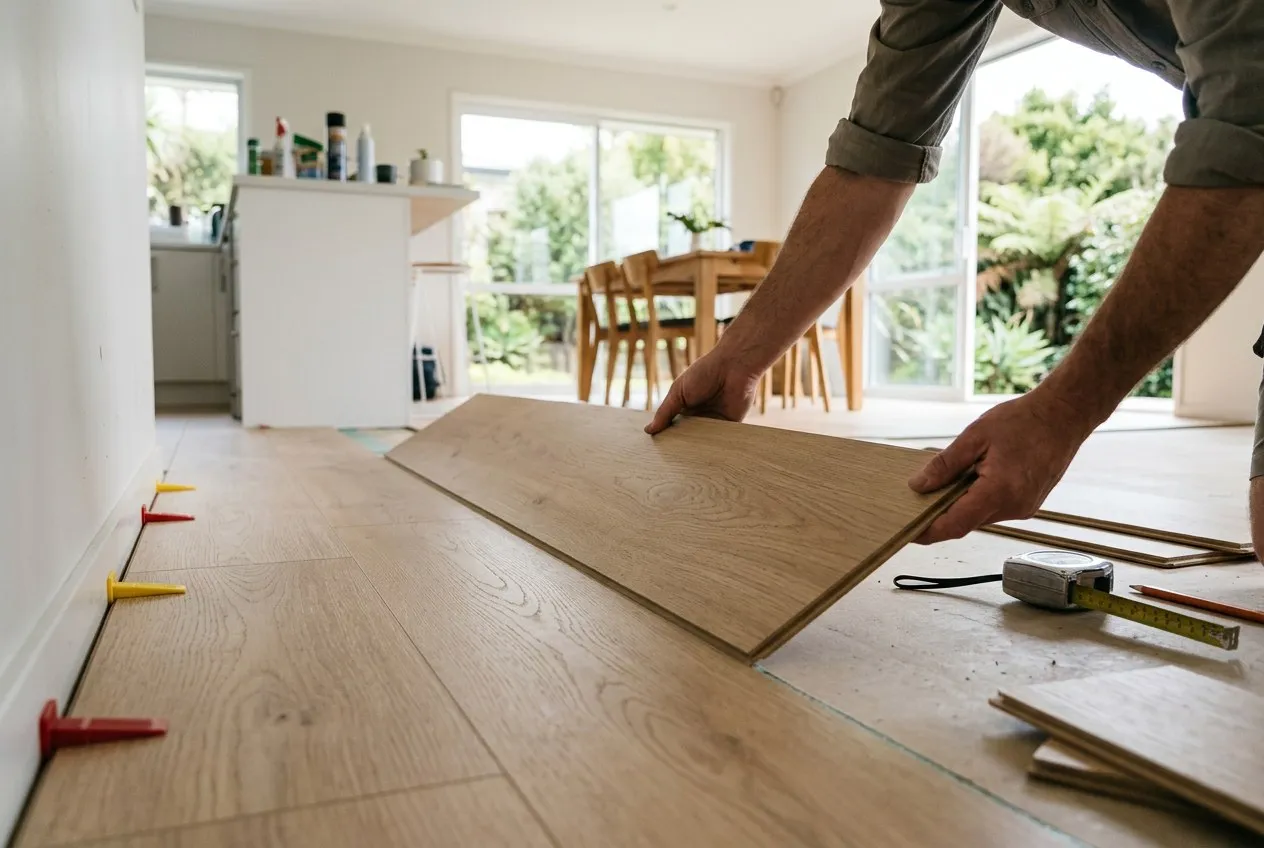
Hybrid is usually sold as SPC (stone plastic composite): a vinyl plank on a rigid core, usually with underlay attached, laid as a floating floor that has to be free to move. Throughout this guide we use Godfrey Hirst’s instructions as the example. Its NZ hybrid instructions say nothing should be fixed through the floor. Other makers set their own rules.
Published hybrid prices vary widely (Ecodure’s own pages give installed ranges from $70 to $180/m²), which is why we show a mid-range and a premium range. Choosing between the three is covered in our comparison of carpet, vinyl and hybrid for NZ homes.
Subfloor prep and the cost to level a floor
| Prep | Per m² |
|---|---|
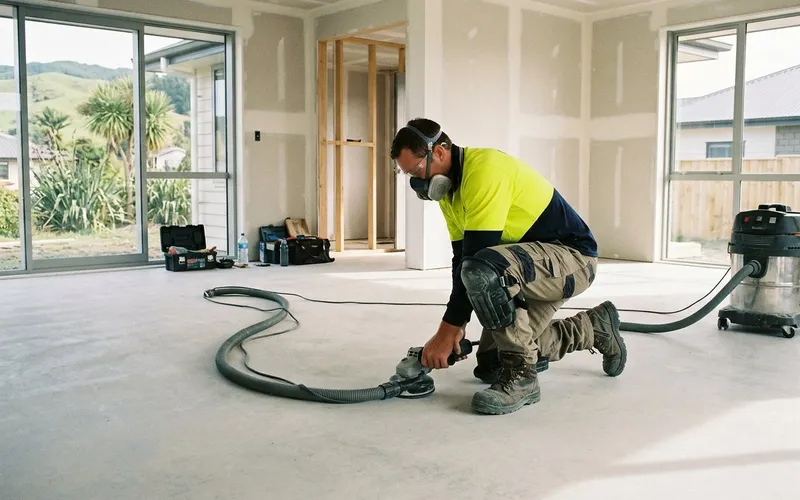
| Routine grinding, or a thin coat of levelling compound | $10–$30 |
| Full levelling on uneven slabs or timber | $25–$80 |
In our view, prep moves a vinyl or hybrid quote more than any other line. The grinding and thin-coat figure is from one national guide (Tradie Tools). Full levelling figures are from Auckland sources: Trade Directory gives $25–$60/m², and Auckland Floor Prep publishes floor levelling at $48–$80/m². Auckland Floor Prep says the amount of levelling compound needed has the biggest effect on its price. Put simply, the deeper the dips, the more you pay. Trade Directory’s figure is labour only, so ask whether compound is included.
Ask for prep as its own quote line, with the method. Structural repairs (joists, re-piling) are a separate job, quoted after an inspection.
Flatness and moisture: what the installer checks
FloorNZ’s guideline allows no more than 3 mm under a 3 m straightedge for resilient floors (vinyl, lino and similar) where the maker sets no tolerance, while Godfrey Hirst asks for 2 mm over 1 m and warns that an uneven floor can break hybrid’s locking system. Concrete slabs also get a moisture test. Limits differ by document, so the quote should say who tests, what limit applies, and what happens if the slab fails. Godfrey Hirst’s instructions also rule out electric radiant heating under hybrid, though properly installed hydronic (hot-water) underfloor heating is fine.
Can you lay over the old floor?
Sometimes. Godfrey Hirst allows its hybrid over most existing floorcoverings, such as ceramic tiles, linoleum or PVC, if the old floor is sound, smooth, flat, clean and dry. Tile grout lines must be no more than 3 mm wide and 3 mm deep, or filled with leveller. That can save the cost of removal, but check the instructions for your own product.
If the old floor has to come up
| Old floor | Removal per m² (Auckland Floor Prep’s published prices) |
|---|---|
| Carpet | $10–$14 |
| Vinyl or lino | $18–$26 |
| Tiles | $48–$68 |
| Timber | $54–$72 |
Ask whether disposal is included. Tradie Tools gives lower figures: carpet $5–$12/m² and tiles $15–$30/m².
Asbestos in old vinyl. WorkSafe says buildings built before 1 January 2000 probably contain some asbestos, and lists vinyl flooring among the places it’s commonly found in homes. In a house that old, have the old vinyl or lino and its adhesive checked by a competent asbestos surveyor before anyone lifts them. Friable material (asbestos that can be crumbled to powder by hand when dry), which includes the paper backing on old sheet vinyl and lino, needs a Class A licensed removalist, and WorkSafe has separate guidance for floor tiles and mastic (adhesive) with no paper backing. See our guide to health and safety on flooring jobs.
Does vinyl or hybrid flooring need underlay?
Hybrid usually has it built in. Ecodure describes rigid core plank as sitting “over a thin underlay (often pre-attached)”. Don’t add a second underlay unless the maker approves.
Sheet vinyl and glue-down plank don’t use a cushioned underlay. On concrete they go onto the prepared slab. On timber floors they often go over a stapled board underlayment (a thin plywood or hardboard sheet), so ask whether it’s in the quote.
So what goes under vinyl flooring? A well-prepared subfloor, sometimes a moisture membrane, and (for Godfrey Hirst’s hybrid over rough subfloors such as chipboard) plastic sheeting. The $10–$25/m² underlay price in general cost guides is for carpet, so leave it out of a vinyl or hybrid budget.
Apartments: noise rules, approval and acoustic underlay
On a 150 mm concrete slab, carpet on carpet underlay is enough to meet the Building Code’s impact-sound requirement under Acceptable Solution G6/AS1, according to Belgotex. Plain vinyl gives far less impact-noise reduction (figures below), and hybrid figures vary by product. So swapping carpet for a hard floor commonly needs body corporate approval, and often an acoustic system (an acoustic underlay or an acoustic-backed product).
What to do before you buy
- Find your body corporate’s operational rules.
- Send the building manager or committee the product data sheet, the underlay data sheet with its test standard, and the install method.
- Ask whether an acoustic test is required after installation.
- Wait for written approval before you order anything.
A body corporate can add to or change its operational rules when the change relates to the management, use or enjoyment of the units or common property, and owners and the body corporate can enforce them (Unit Titles). Power Dekor Floors’ guide (September 2026) says such rules commonly require written approval before carpet is replaced with a hard floor, that some set a minimum acoustic rating, and that approval can take anywhere from a couple of weeks to four to six weeks or longer.
What the Building Code asks for
Building Code clause G6 requires walls, floors and ceilings between household units to have a Sound Transmission Class (STC) of at least 55, and floors an Impact Insulation Class (IIC) of at least 55. IIC rates impact noise, such as footsteps, through a floor. It applies to the whole floor assembly, so an underlay on its own can’t have a true IIC, as Power Dekor notes. Belgotex puts a bare 150 mm slab at about IIC 25 and says high-end apartments “may target IIC 60-70”. In our view, when you re-floor in an existing building, the number that matters is the one in your body corporate’s rules, if they set one.
How much difference vinyl makes
Belgotex’s acoustics guide also gives impact sound reduction, written ΔLw: the decibels a floor covering takes off impact noise. It’s a different scale from IIC, so you can’t add the two. Plain LVT (luxury vinyl tile) reduces impact sound by only 3–4 dB, or 18 dB with acoustic backing. Heterogeneous (multi-layer) sheet vinyl manages 3–8 dB, or 17–19 dB with acoustic backing. Carpet tile with EcoBac (a branded carpet-tile backing) gives 28–30 dB.
What acoustic underlay costs
The only NZ price we could source is an acoustic cork underlay listed by Expert Flooring: $24.90/m² for 3 mm and $38.90/m² for 6 mm. That’s supply only and GST isn’t stated. Both product pages list an impact sound reduction of 18 dB but give no test standard and no IIC for a finished floor. We found no sourced price difference between acoustic-backed and standard hybrid. Example 3 below shows what to ask about a 45 m² apartment.
Can you put vinyl or hybrid in the kitchen, laundry or bathroom?
Yes, with conditions that change the price. Building Code clause E3 requires wet-area surfaces to be impervious and easily cleaned, and FloorNZ’s guideline notes that E3 identifies a bathroom, laundry, toilet or kitchen (areas with taps) as a wet area. Under E3/AS1, the standard answers are tiles over a membrane, or sheet vinyl with welded or sealed joints. Some hybrids carry E3 compliance statements, so check the product. Click vinyl plank isn’t waterproof at the joints.
Vinyl and hybrid are both common in kitchens, but because a kitchen is a wet area, use sheet vinyl or a product with an E3 compliance statement, and follow the maker’s instructions (for Godfrey Hirst’s hybrid, that includes a 10 mm expansion gap around cabinetry and island benches). Bathrooms are stricter: Godfrey Hirst allows only one named hybrid range in wet areas, in rooms under 8 m² with no floor waste (drain) or freestanding bath, among other conditions. Don’t price a bathroom from the plank rate: expect sealing, thresholds and sometimes a different product. A 6 m² laundry in sheet vinyl is 6 m² × $35–$70 = $210–$420 before prep, but small jobs often carry a minimum charge, so ask.
Scotia, skirting and trims: what they cost
A floating hybrid floor needs an expansion gap around the edge (Godfrey Hirst: at least 10 mm at every fixed vertical surface). The gap is covered by skirting, or by scotia (a small moulding fixed along the bottom of the skirting) and end caps. Alternatively, the skirting can be undercut. Whichever is used, it’s fixed to the wall, never through the floor. If the gaps are too small, Godfrey Hirst warns, the floor can buckle, peak, cup or separate.
Perimeter example: a 4 m × 5 m room in hybrid
| Line | Maths | Cost |
|---|---|---|
| Perimeter | 2 × (4 + 5) = 18 m, less about 1 m for a doorway = about 17 m | |
| Scotia, off-the-shelf white 2.4 m (Bunnings NZ listing: $19.97 a length, about $8.32 a lineal metre) | 8 lengths (19.2 m) × $19.97 | About $160, supply only |
| Or new skirting ($30–$60 per metre of perimeter, Tradie Tools) | 17 m × $30–$60 | $510–$1,020, painting extra |
Bunnings NZ also lists 3.3 m doorway ramp and threshold trims at $40.27–$76.40. For this room, scotia and new skirting are several hundred dollars apart, so ask which one is priced. Tradie Tools’ guide to timber flooring costs says its headline prices include standard skirting and threshold finishing, so check whether your vinyl or hybrid quote does too before adding these figures on top.
Worked examples: what a 20 m², 30 m² or 45 m² job comes to
These totals are Underfoot’s own arithmetic from the published per-m² ranges in this guide. They’re not quotes. Sources differ on GST, too, so read them as a guide to the size of the bill.
Example 1: 20 m² rental living room and bedroom, carpet to vinyl plank, concrete slab
| Line | Maths | Cost |
|---|---|---|
| Vinyl plank, mid-range, supplied and installed | 20 m² × $60–$100 | $1,200–$2,000 |
| Carpet removal (Auckland Floor Prep rates) | 20 m² × $10–$14 | $200–$280 |
| Total without prep | $1,400–$2,280 | |
| Routine grinding if the slab needs it | 20 m² × $10–$30 | $200–$600 |
| Total with grinding | $1,600–$2,880 |
Example 2: 30 m² kitchen and dining, old sheet vinyl to hybrid, uneven floor
| Line | Maths | Cost |
|---|---|---|
| Hybrid, mid-range, supplied and installed | 30 m² × $80–$120 | $2,400–$3,600 |
| Vinyl removal (Auckland Floor Prep rates) | 30 m² × $18–$26 | $540–$780 |
| Total without levelling | $2,940–$4,380 | |
| Full levelling of the whole floor | 30 m² × $25–$80 | $750–$2,400 |
| Total with levelling (worst case) | $3,690–$6,780 |
That’s a worst case: it levels all 30 m². The kitchen end is a wet area under E3, so the hybrid you price needs an E3 compliance statement (or use sheet vinyl there). We found no separate price for a hybrid with an E3 statement, so ask whether the quoted product has one. If the maker allows hybrid over sound existing vinyl, the removal line may drop out, but in a pre-2000 house get the old vinyl checked for asbestos first.
Example 3: 45 m² apartment in hybrid, what to ask before adding acoustic underlay
| Line | Maths | Cost |
|---|---|---|
| Hybrid, mid-range, supplied and installed | 45 m² × $80–$120 | $3,600–$5,400 |
Don’t just add a separate acoustic underlay: many hybrids have underlay attached, and a second layer needs the maker’s approval. Ask instead:
- Does the body corporate require an acoustic rating, and which one?
- Does your hybrid meet it with its attached underlay, or do you need an acoustic-backed product?
- If the maker approves a separate underlay, what does it cost to supply and fit?
As a reference point, not a total: the one acoustic underlay we could price would cost 45 m² × $24.90–$38.90 = about $1,121–$1,751 to supply, before fitting. The range covers Expert Flooring’s 3 mm and 6 mm versions, which list 18 dB impact sound reduction but no test standard. If your quote’s acoustic line is well above that plus fitting, ask what it covers.
How much extra does Auckland cost?
Tradie Tools puts Auckland 10–15% above its national prices, and Trade Directory says Auckland labour sits at the higher end of NZ rates because of stronger demand, higher business overheads and travel time. Apply that to one sourced figure: on vinyl labour of $20–$40/m², 10–15% more works out at roughly $22–$46/m², or about $120–$360 extra on a 60 m² job. Wherever you are, compare local quotes.
How to compare vinyl and hybrid quotes
Ask each installer to quote the same scope, line by line. These lines matter most on vinyl or hybrid:
| Line | What to ask | Why |
|---|---|---|
| Product | Brand, range, wear layer (the protective top coat), thickness | “Hybrid” covers very different products |
| Prep and levelling | Its own line, with the method | Often the line that moves the price most |
| Moisture test | Who does it, what limit, what if the slab fails | Limits differ by document |
| Underlay or membrane | Attached, extra or not needed? | Avoids doubling up or missing a membrane |
| Trims, scotia, thresholds | Which, how many metres, fitted or supplied | Scotia and new skirting differ a lot |
| GST | Included or excluded? | Labour-only rates are sometimes quoted excl. GST |
Ask for each of these as its own line too, since we found no published prices for them: asbestos testing and removal, fitting scotia, colour-matched scotia, undercutting door jambs, a separate acoustic underlay, and any small-job minimum.
Quotes, deposits and variations
Consumer Protection says a quote is an offer to do a job for a specified price, while an estimate isn’t a fixed price. Once you accept a quote, the provider can’t charge more unless you agree to extra work (a variation). For deposits and what else a quote should cover, see how to read a flooring quote in our all-floors guide.
What to do next
- Note your rooms and subfloor. Sizes in m², concrete or timber, the current floor, and whether the house was built before 2000.
- Check the rules. In an apartment, work through the four steps above first. In a kitchen, bathroom or laundry, check the product’s wet-area documentation.
- Get itemised quotes on the same scope. If the floor needs levelling, ask whether the installer does it or you need a floor-prep firm. Outside Auckland, search “floor levelling” or “floor preparation” plus your town, and ask for a per-m² price with the compound depth stated. Our guide on how to vet a flooring installer is written for Auckland, but most of its checklist works anywhere in NZ.
Flooring Design, an NZ flooring retailer, says vinyl plank and laminate are the fastest floors to lay, with about 100 m² usually done in 1–2 days, plus any prep. The carpet, laminate and timber prices are in our all-floors cost guide, if you’re pricing a mix of floors.
Methodology and sources
Checked 27 Oct 202626 sources
Ranges compiled from published NZ retailer, installer and cost-guide pricing, checked on 27 October 2026. Sources are listed below.
These are published figures. Underfoot has not collected quotes. The worked examples are our own arithmetic from the ranges in this guide: the area multiplied by the bottom and top of each published rate. GST status varies by source. Where sources disagreed, we used the range most of them support. The sheet vinyl range rests on Tradie Tools: its vinyl cost guide, with its calculator (sheet vinyl installed $45–$70) supporting the $70 top end. The vinyl labour rate of $20–$40/m² is from one national guide (Tradie Tools vinyl).
Prices (7)
- Tradie Tools: vinyl flooring cost NZ (GST inclusive, updated June 2026)
- Tradie Tools: timber flooring cost NZ
- Tradie Tools: carpet and flooring calculator
- Ecodure: vinyl flooring guide
- Ecodure: guide to flooring types in New Zealand
- Ecodure: hybrid vs timber flooring
- Trade Directory: flooring installer cost Auckland (self-described 2024/2025 rates)
Prep, removal and installation (7)
- FloorNZ: best practice guidelines, resilient floor coverings (June 2019)
- Godfrey Hirst: hybrid installation instructions (NZ)
- Auckland Floor Prep: floor levelling
- Auckland Floor Prep: flooring uplifters
- WorkSafe: where asbestos can be found
- WorkSafe: asbestos licensing overview
- WorkSafe: removing asbestos-containing floor tiles and mastic (no paper backing)
Apartments and acoustics (6)
Wet areas (3)
- Building Performance: E3 internal moisture
- E3/AS1 internal moisture, 2nd edition, amendment 7 (PDF)
- Neptune: E3/AS1 alternative solution compliance statement (PDF) (example of a hybrid maker’s E3 statement)
Trims (1)
- Bunnings NZ: flooring trims (prices as listed)
Quotes and timing (2)
For what happens between accepting a quote and walking on the finished floor, lead times included, read our guide to what happens on flooring installation day.