Health and safety on flooring sites in New Zealand sits in an awkward space. The Health and Safety at Work Act 2015 imposes serious obligations on installers as PCBUs (Persons Conducting a Business or Undertaking). Most installers know this in principle. In practice, residential flooring sites get treated as low-risk and the obligations get under-applied — until something goes wrong.
This piece is the practical guide to what WorkSafe NZ actually requires from flooring installers, what the realistic standard looks like on residential sites, and where most installers fall short.
The legal framework in 30 seconds
You’re a PCBU under the Health and Safety at Work Act 2015. As a PCBU, you have a primary duty to ensure the health and safety of:
- Workers (including yourself if self-employed, your employees, contractors, apprentices)
- Other persons affected by your work (homeowners, family members on-site, other trades, visiting suppliers)
This primary duty requires you to identify hazards, eliminate them where reasonably practicable, and minimise them where they can’t be eliminated. Documentation is part of this — not as bureaucracy, but because in a WorkSafe investigation, undocumented practices are functionally equivalent to absent ones.
The Act applies to residential flooring sites the same way it applies to commercial construction. The standards are the same; the practical risks are different.
What’s actually required on a flooring site
For a typical residential carpet/vinyl/hard flooring install, these are the H&S requirements that apply:
1. Hazard identification and the hazard register
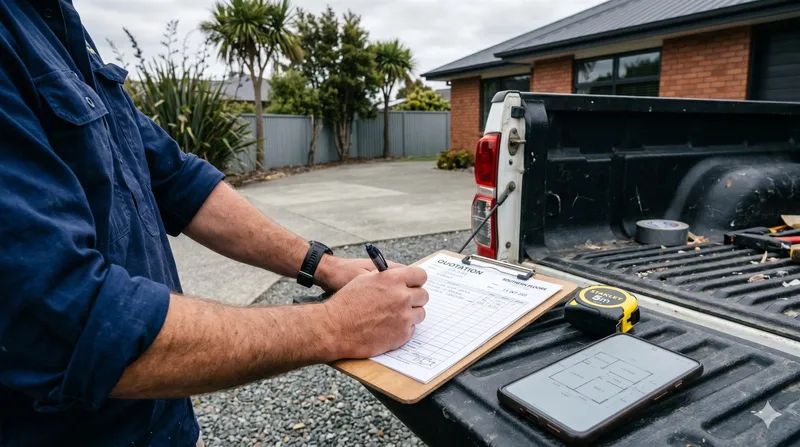
Before starting work, you should identify and document the hazards specific to the site and the work. The FloorNZ-aligned hazard register format covers the typical risks:
- Manual handling — lifting heavy rolls, bending, kneeling, repetitive cuts
- Sharp tools — knives, blades, electric trimmers, cut hazards
- Electrical — power tools, extension leads, residential wiring concerns
- Dust and fumes — adhesives, silica from concrete prep, dust from existing floor removal
- Asbestos — particularly for older homes (vinyl tiles 1960s-80s, some textured ceiling treatments, fibrolite cement)
- Slip and trip — uplifted flooring, tools, materials laid out
- Working at height — stairs, raised areas, sometimes ladders for trim work
- Other trades on site — coordination with builders, electricians, plumbers if renovation work is parallel
- Pets and children — animals and children present during work add specific risks
A hazard register is a living document for the specific job — not a one-time form. You update it when conditions change (new hazards discovered during prep, additional trades arriving, etc.).
2. Personal protective equipment (PPE)
Mandatory PPE varies by task but typical requirements include:
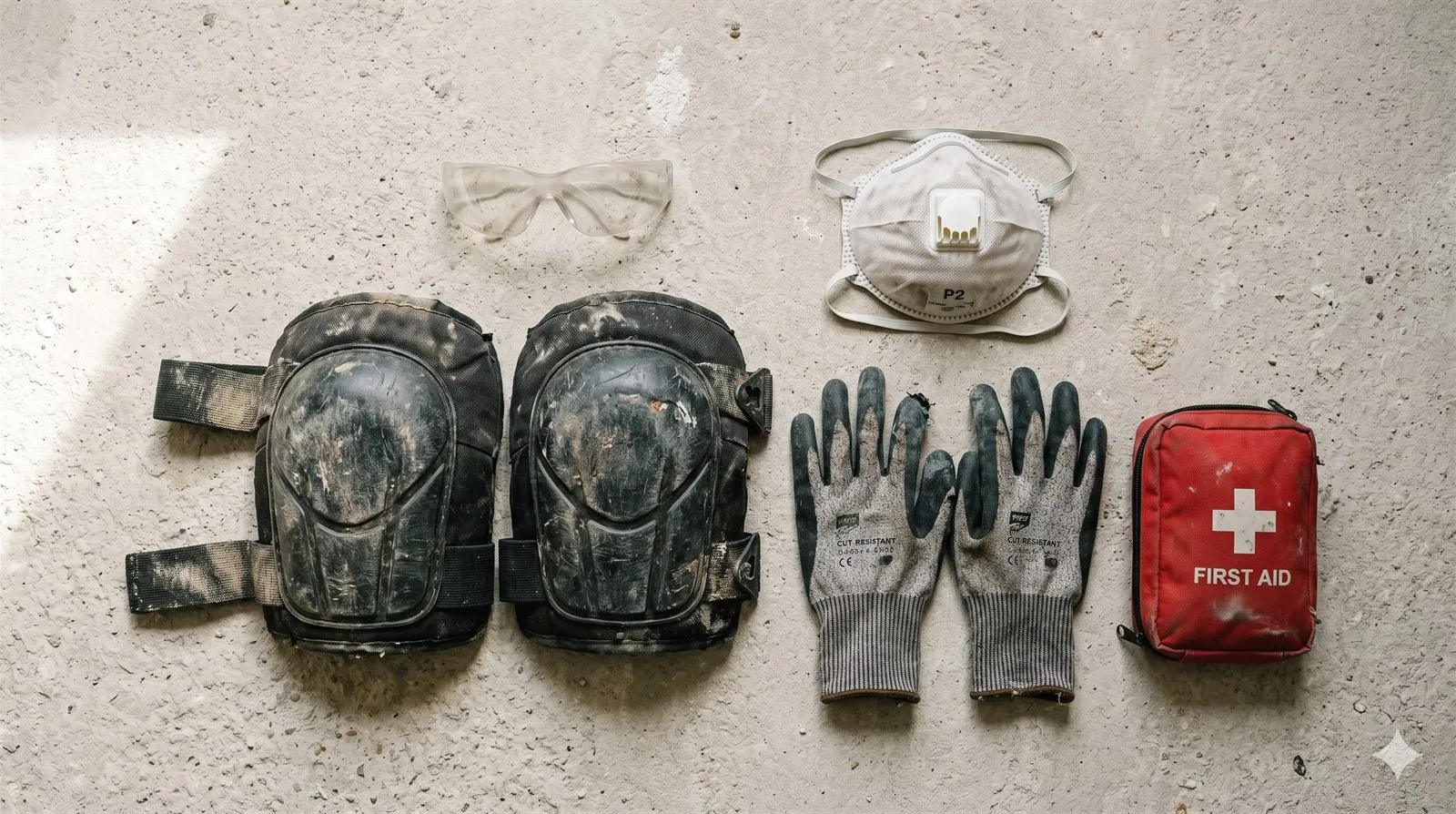
- Knee pads for prolonged kneeling work
- Safety glasses when cutting, especially for vinyl plank, laminate, hard flooring
- Hearing protection for sustained power tool use (sanders, saws)
- Dust masks (P2 minimum) for any task generating dust — sanding, concrete prep, removing existing flooring
- Steel-capped boots are generally expected, though residential carpet installers sometimes work in soft-sole (acceptable if the risk profile of the specific job permits)
- Gloves for handling rolls, sheet vinyl, and during demolition tasks
PPE provided to workers must be fit for purpose — not the cheapest available. Documented PPE provision and training in correct use is part of compliance.
3. Asbestos awareness and management
Older NZ homes (pre-2000, especially 1960s–1980s) may contain asbestos in:
- Vinyl floor tiles and the adhesive used to lay them
- Sheet vinyl backings and underlays from that era
- Cement-based materials under existing flooring (in some cases)
Before removing any pre-2000 flooring, the law requires a review for asbestos containing materials (ACMs). If the floor was installed pre-2000 and you don’t know what’s under it, you need:
- Visual inspection by someone competent to identify likely ACMs
- Sampling and testing if visual inspection is uncertain (this is what asbestos surveyors do)
- Removal by a licenced asbestos remover if ACMs are confirmed and being disturbed
Disturbing asbestos without proper procedure isn’t just illegal — it exposes you, the homeowner, and any other trades on site to a known carcinogen. WorkSafe takes this seriously and prosecutes.
For installers without asbestos training, the right move is to not start work when you suspect ACMs and refer the homeowner to a licenced asbestos surveyor. This is legally protective and ethically correct.
4. Dust and silica exposure
Concrete prep and grinding generate respirable crystalline silica (RCS) — a known cause of silicosis and lung cancer. WorkSafe has tightened requirements around silica exposure substantially in recent years.
Practical requirements for residential sites:
- P2 respirator minimum when grinding concrete, sanding, or generating fine dust
- Vacuum extraction on power tools where available — most quality grinders and sanders have integrated extraction or HEPA vacuum attachments
- Wet methods where possible (wet cutting, water-based prep) to suppress dust
- Site isolation when extensive dust work is underway — closing off the work area, advising householders not to enter
Most installers underestimate silica risk because residential exposure is intermittent. The risk accumulates over a career. Long-term protection matters even if any single job’s exposure feels minor.
5. Manual handling
Flooring is physically demanding work. WorkSafe requires you to assess and manage manual handling risks:
- Carpet rolls are heavy (often 100kg+ for full rolls). Two-person lifts, mechanical aids (hand trolleys, rollers), or pre-cutting into sections are appropriate measures.
- Sustained kneeling causes long-term knee damage. Knee pads, frequent breaks, varied work positions.
- Repetitive cutting and trimming causes wrist and shoulder injuries. Tool selection (proper handles, sharp blades, ergonomic knives) reduces this.
- Subfloor prep can involve significant lifting (bags of self-levelling, tools, materials). Plan loading and unloading; use trolleys.
Manual handling injuries are the most common cause of installer downtime. They’re usually preventable.
6. Electrical safety
Residential flooring sites have specific electrical risks:
- Damaged extension leads from being trailed across work areas
- Overloaded circuits when running multiple power tools through a single outlet
- Wet conditions (cleaning, residual moisture in subfloor) increasing electrical risk
- Cutting into floor coverings that conceal wiring (uncommon but possible in DIY homes)
Use of portable RCDs (residual current devices) on extension leads is best practice, especially for older homes where you don’t know the state of the wiring. RCDs are legally required for some commercial sites and worth using on residential sites regardless.
7. Working with other trades
If the renovation has builders, electricians, plumbers, or painters on-site simultaneously:
- Coordinated PCBU obligations apply — you and the other trades have overlapping duties
- Site-specific risk assessment should consider what they’re doing alongside what you’re doing
- Communication on-site about hazards each party introduces
In practice, most residential renovations have a lead contractor (builder) who coordinates. Your obligations as the flooring installer extend to your work and its interactions with theirs.
What documentation looks like
For a typical residential flooring installation, your H&S documentation should include:
Pre-job:
- Site-specific hazard register (or hazard identification record)
- Asbestos check / declaration if pre-2000 home
- PPE briefing record (especially for apprentices or new staff)
- Any sub-contractor agreements with H&S obligations attached
During job:
- Daily hazard observations (particularly if conditions change)
- Incident or near-miss documentation if anything occurs
- Variations to the original hazard register if new risks appear
Post-job:
- Site cleanup record
- Any incidents that need reporting to WorkSafe (serious harm, notifiable events)
This sounds like a lot. In practice for a competent installer it’s a 15-minute pre-job ritual, a 5-minute daily check, and a 5-minute close-out — all on a single page or in a basic app.
Where most installers fall short
We’ve talked to working installers about H&S practice. The common gaps:
1. Treating hazard registers as paperwork to fake. Installers who fill in identical hazard registers regardless of site fail their primary duty. The register has to be site-specific and actually reflect the hazards. Cookie-cutter forms don’t satisfy WorkSafe in an investigation.
2. Underestimating dust and silica exposure. “It’s only a small bit of grinding” is the most common excuse for not using proper extraction or respirators. The cumulative exposure over a career is what matters. WorkSafe has prosecuted sustained patterns of inadequate dust control.
3. Assuming pre-2000 homes are fine. “There’s probably no asbestos” without actually checking is gambling with a known carcinogen. The legal default in pre-2000 homes is to assume ACM until proven otherwise.
4. Working alone on heavy lifts. Self-employed installers especially try to handle heavy carpet rolls alone. The acute injury risk is real and the long-term impact on the body is worse. Get help, use mechanical aids, or pre-cut.
5. Not training apprentices in H&S formally. Apprentices often learn H&S informally — by watching their senior. This isn’t enough under the Act. Formal training and documentation of training is required for new workers.
What WorkSafe actually does about residential flooring
WorkSafe’s enforcement focus has historically been heavier on commercial construction than residential. That’s changing — particularly around silica exposure, asbestos, and serious injury patterns.
What we see in practice:
- Inspector visits to residential flooring sites are uncommon but not zero. They occur, particularly if there’s been a complaint or pattern.
- Investigation triggers are usually serious harm events — injury hospitalisations, asbestos exposure, electrical incidents.
- Penalties for non-compliance can be substantial — fines into hundreds of thousands of dollars are not unheard of for serious breaches with serious harm.
- Documentation is the difference between a dispute and a prosecution. Comprehensive records of your H&S practice protect you in any investigation.
The right framing isn’t “what’s the minimum I can do to avoid prosecution.” It’s “what level of practice protects me, my workers, my customers, and my long-term career.”
The realistic standard
For a working independent installer in 2026, the realistic standard looks like:
- Site-specific hazard register completed before each job
- Asbestos check on pre-2000 homes (visual inspection at minimum, surveyor referral if uncertain)
- P2 respirators worn for any dusty task, no exceptions
- Knee pads always
- Safety glasses for cutting work
- Hearing protection for power tools used > 30 minutes
- Two-person lifts or mechanical aids for full carpet rolls
- Documented PPE training for any apprentices or new staff
- Basic incident reporting if anything happens
This is achievable, doesn’t require expensive equipment, and is what FloorNZ-aligned standards roughly require. Most installers we’ve talked to who claim to do this actually do roughly half of it consistently.
Resources
- WorkSafe NZ: worksafe.govt.nz — current guidance, hazard guidance, prosecution case studies
- FloorNZ: floornz.org.nz — industry-specific H&S guidance, hazard register templates
- Site Safe NZ: sitesafe.org.nz — broader construction H&S training and resources
We’ll continue covering H&S developments — particularly silica exposure rules, asbestos enforcement patterns, and any flooring-specific guidance updates from WorkSafe. Subscribe at underfoot.co.nz/newsletter for updates.
If you’ve had a WorkSafe interaction (positive or negative), or have specific H&S practices you want to share, email us at hello@underfoot.co.nz. Real-world experience makes this content sharper.