Most New Zealand homeowners researching flooring start with the same question: how much is this going to cost me? And most of the answers are awful — vague retailer “from $X” pricing, US/UK guides with irrelevant numbers, or Facebook anecdotes that may or may not reflect 2026 reality.
This piece is the answer we wanted to read when we started. Honest 2026 New Zealand pricing across the major flooring categories, what’s actually in a quote, where the costs hide, and how to know when you’re being rolled.
The short answer
For a typical 100m² house in Auckland or Wellington, expect a total flooring installation cost — supply, prep, and labour combined — of roughly NZ$6,000 to $40,000+ depending on what you choose. That range is wide because the difference between budget carpet and premium engineered timber is enormous.
Here’s the per-square-metre supply-and-installed range by category, drawn from current NZ retailer pricing and installer quotes:
| Category | Per m² (supply + installed, mid-range) | Per m² (premium) |
|---|---|---|
| Carpet (synthetic) | $50–$80 | $90–$140+ |
| Carpet (wool / wool-blend) | $60–$100 | $120–$190+ |
| Vinyl plank (LVP) | $75–$130 | $140–$200 |
| Hybrid / SPC | $80–$120 | $130–$180 |
| Laminate | $70–$110 | $120–$160 |
| Engineered timber | $250–$350 | $385–$480+ |
| Solid timber | $350–$500 | $550+ |
These numbers reflect 2026 NZ market ranges drawn from public retailer pricing, installer quotes, and product-side figures. They are not based on US or Australian figures, and they reflect actual installed cost — not the misleading “from $X per m²” supply-only figures retailers love to put on their websites.
The difference in scale between resilient/carpet ranges and timber ranges is real and worth understanding: timber is materially more expensive both because the product itself costs more and because installation is more labour-intensive (acclimatisation, sanding/finishing where applicable, expansion-gap planning).
What’s actually in a flooring quote
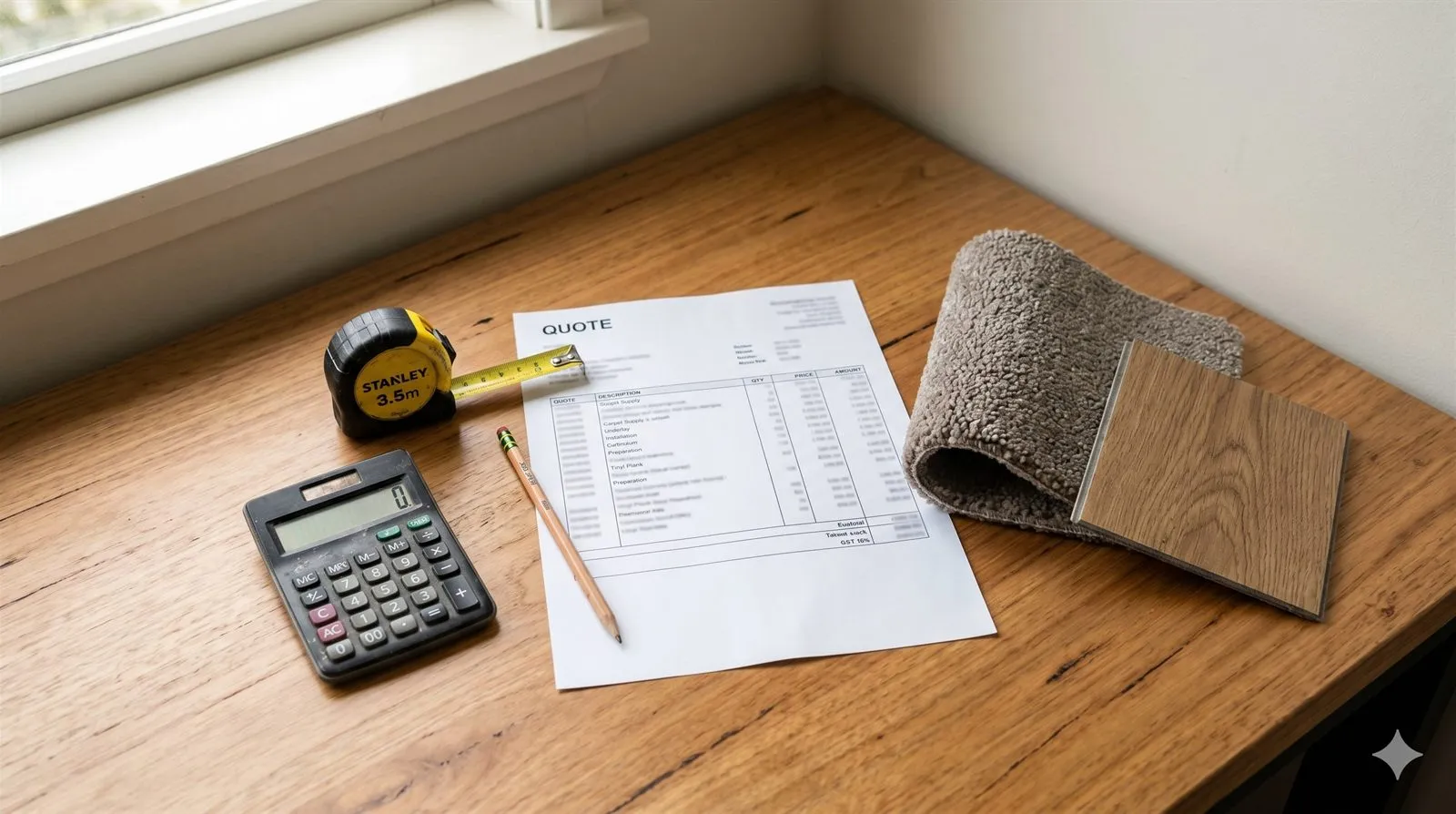
A flooring quote should cover six things. If yours is missing any, ask why.
1. Product supply. The flooring itself — carpet rolls, vinyl planks, timber boards, etc. This is usually the line item retailers compete on, which is why you’ll see big “from $40 per m²” signs in stores. That’s almost always supply only, which is roughly half the eventual installed price.
2. Underlay or substrate prep. Carpet needs underlay. Vinyl and hybrid need a smooth, level subfloor — sometimes self-levelling compound, sometimes a moisture barrier. Hard flooring needs the same plus expansion gap planning. Underlay is typically $10–$25/m². Self-levelling can add $30–$80/m² to a problem subfloor.
3. Uplift and disposal of existing flooring. Removing carpet is straightforward. Removing tile or vinyl glued to a subfloor can be a substantial job. Disposal fees apply — often $200–$500 per skip-load.
4. Furniture moving. Some installers move furniture as part of the job, others charge separately, others don’t do it at all. Get this in writing before you commit.
5. Installation labour. The skilled work — laying, cutting, joining, finishing. Labour rates in NZ vary by category and region. Auckland labour is typically 10–20% higher than smaller centres.
6. Trim, transitions, and skirtings. Where the floor meets a wall, a doorway, or another floor type, you need trim. New skirtings (if old ones are damaged when carpet comes up) are an extra cost. Door undercutting (if hard flooring increases the floor height) is another.
A quote that gives you a single number with no line items isn’t a quote — it’s a guess.
Where the cost hides: subfloor preparation
The biggest budget surprise in flooring projects is almost always subfloor prep.
Vinyl, hybrid, and laminate flooring need a smooth substrate. If your existing subfloor is concrete with cracks, divots, or moisture, or if it’s particle-board over joists with movement, the installer may need to apply self-levelling compound, install a moisture barrier, or replace damaged areas.
This work isn’t visible in the finished floor, which is why it’s tempting for some retailers and installers to skip it. But skipping it is what causes the floor failures you read about in Facebook groups two years later — telegraphing of cracks through to the surface, edge curling on vinyl, hollow spots underfoot, premature wear.
If your installer doesn’t ask about your subfloor, or if their quote has no line item for subfloor prep when they’re laying vinyl over old tile, walk away. The savings aren’t real.
A reasonable subfloor prep budget for routine work is $10–$30/m² for levelling and grinding on concrete, $20–$50/m² for full prep on uneven slabs or timber subfloors. Extensive remediation (waterproofing, structural repair) sits well above this and gets quoted separately after inspection.
Regional pricing — Auckland, Wellington, Christchurch, and the rest
NZ flooring isn’t a single market. Pricing varies meaningfully by region:
- Auckland: 10–20% premium on labour rates, driven by trade scarcity. Material pricing is similar to elsewhere because suppliers are national.
- Wellington: similar to Auckland on labour for skilled trades, slightly less for general carpet installation.
- Christchurch and major South Island centres: typically the lowest labour rates of the main centres, though premium installers price closer to North Island rates.
- Smaller regional centres: cheaper labour but a thinner pool of installers, which means longer wait times and less competition on price. The two effects roughly cancel out.
The biggest regional factor is actually availability. In Auckland, you can get three quotes within a fortnight. In a smaller town, you might be waiting two months for the only competent installer in the region. That waiting time has its own cost.
What “from $X per m²” actually means at retailers
When you see “carpet from $39 per m²” in a retailer’s window, three things are usually true:
- That’s the supply-only price for the cheapest carpet they stock, in the cheapest grade. The carpet you actually want is more.
- It doesn’t include underlay (typically $15–$25/m²).
- It definitely doesn’t include installation (typically $30–$55/m² for carpet labour).
So that “$39 per m² carpet” becomes an installed cost of roughly $84–$120/m². Not dishonest exactly, but designed to get you in the door before you find out the real number.
The honest way to compare retailers is to ask for supplied and installed quotes, including underlay and any required prep, on a specific room of yours. Anything else is marketing.
How to read a quote
Three things to look for in any quote you receive:
Specifics about your house. A real quote names your floor area, your subfloor type, the rooms involved, and any known issues (level changes, transition points, moisture concerns). If a quote could be for any house in your suburb, it isn’t a quote — it’s a guess.
Itemised lines. Supply, underlay, prep, uplift, disposal, labour, trim. You should be able to see each one separately. A single-figure quote is a black box; that’s a problem.
Realistic timeframes. Quality flooring installation isn’t fast. A 100m² home is typically two-to-four days of on-site work plus prep. Quotes that promise “complete in one day” for a multi-room job are either skipping prep or overpromising.
If you’re getting multiple quotes, ask each installer to give you the same itemised structure on the same scope. That’s the only way to compare them apples-to-apples.
Red flags
- No subfloor inspection before quoting. A quote without a site visit is a finger-in-the-air estimate.
- Big deposit demands (60–75%). Common in NZ flooring retail, but not necessary. A 25–35% deposit is reasonable; anything more is the retailer using your money for cash flow at your risk.
- Vague timeframes. “We’ll fit you in soon” without dates is how jobs slip and customers get forgotten.
- No insurance details. Reputable installers carry public liability insurance and will tell you about it. Ask.
- Pressure to decide today. A real quote is good for at least 14 days. Anyone giving you a “today only” price is selling, not quoting.
Where this pricing comes from
The figures in this piece are drawn from:
- Quotes we’ve collected from multiple installers across Auckland, Wellington, and Christchurch on real residential projects in 2025–2026
- Public retailer pricing as advertised
- Conversations with installers and retailers about their cost structures
- Triangulation against industry data where available
We deliberately don’t quote a single source as “the” NZ flooring price because no such single source exists. The price of flooring varies by region, installer, season, and product availability. What we’ve published here is a credible mid-2026 range.
If you have data that contradicts what we’ve published — a quote that’s wildly outside this range, regional pricing we’ve missed, a category we haven’t covered — tell us at hello@underfoot.co.nz. We update our cost guides as the market shifts and as readers send us better information.
What to do next
If you’re at the start of a flooring project, three concrete steps:
- Pin down your scope. Total floor area to be covered, rooms, subfloor type if you know it. This lets you compare quotes properly.
- Get three quotes from independent installers, not just retailers. Retailers have an incentive to install with their own teams. Independent installers often have better pricing and more flexibility.
- Ask for itemised quotes. Refuse single-figure totals. Ask for line items: supply, underlay, prep, uplift, disposal, labour, trim.
We’re working on a longer piece on how to find a good flooring installer in Auckland — covering the full vetting process — which we’ll publish next. Subscribe at underfoot.co.nz/newsletter to get it when it goes up.