The proposed acquisition of Bremworth by Mohawk Industries — through its New Zealand subsidiary Godfrey Hirst — is the biggest single development in NZ flooring in a decade. It’s also the one most poorly explained in mainstream coverage: reported as a Scheme of Arrangement story in the business pages, but rarely connected to what it actually means for the industry on the ground.
This piece is the independent read on what’s actually happening, what the Commerce Commission has said so far, and what comes next. Written for installers, retailers, suppliers, and anyone watching the NZ flooring industry seriously.
The headline
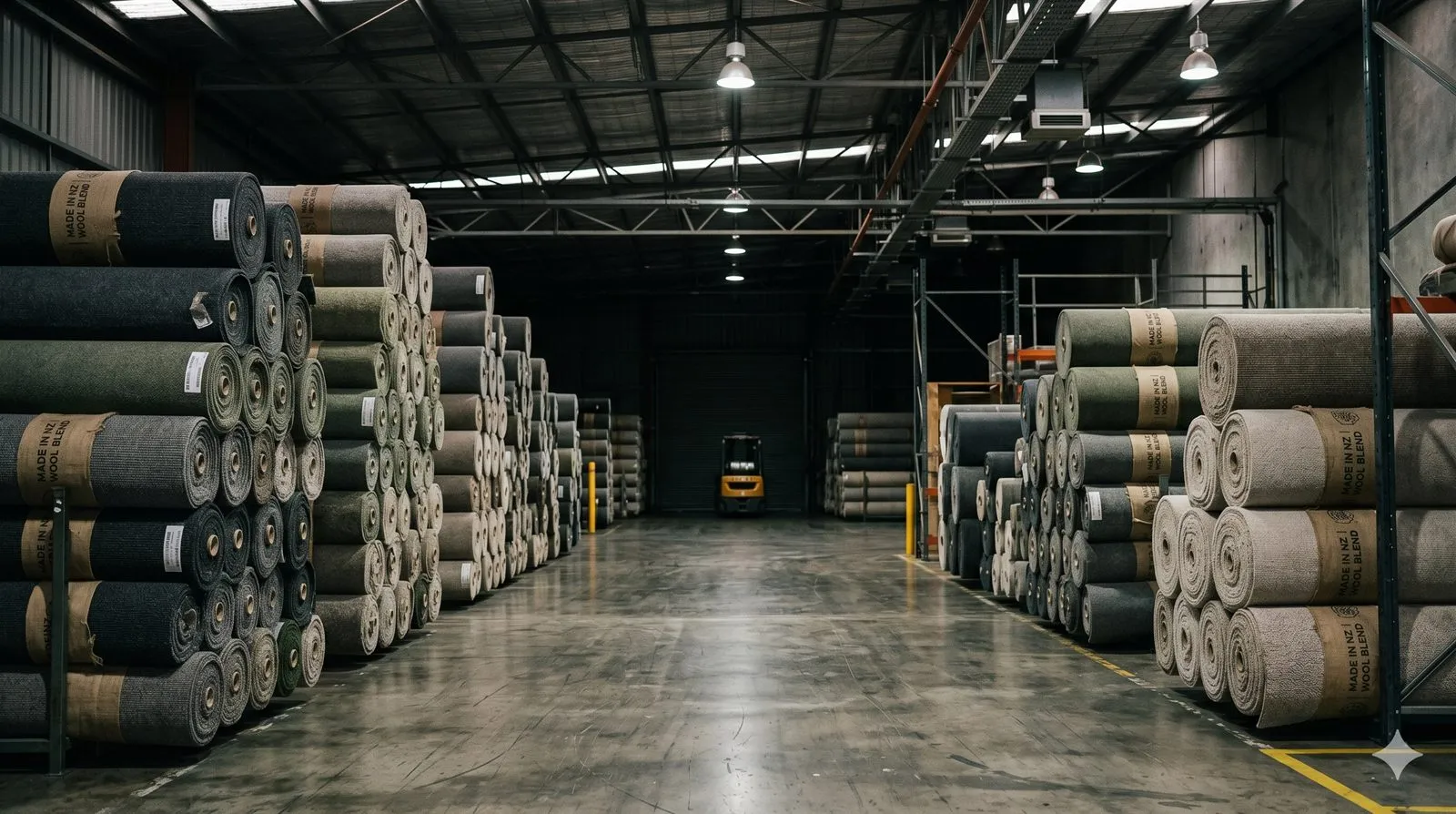
Mohawk Industries, the world’s largest flooring manufacturer, already owns Godfrey Hirst New Zealand — one of the two domestic wool carpet manufacturers operating at scale in this country. In October 2025 it moved to acquire Bremworth (NZX: BRW) — the other one — via a Scheme of Arrangement, with Mohawk’s wholly-owned subsidiary Floorscape Limited as the acquiring vehicle.
The deal would consolidate New Zealand’s two major wool carpet manufacturers under one global owner.
The Commerce Commission has been reviewing it since October 2025. As of mid-April 2026 it is not satisfied the acquisition won’t substantially lessen competition. A determination is currently scheduled for late May 2026.
The timeline so far
- 1–2 October 2025: Bremworth and Floorscape sign a Scheme Implementation Agreement. Bremworth shareholders would receive cash plus a $21–28 million capital return ahead of implementation.
- 24 October 2025: Commerce Commission registers Mohawk’s clearance application.
- 23 December 2025: Commission publishes a Statement of Issues outlining preliminary competition concerns.
- 14 April 2026: Commission publishes a Statement of Unresolved Issues — escalating from “issues to address” to “concerns we are not yet satisfied have been resolved”.
- 29 April 2026: A confidential third-party submission opposing the deal becomes public, arguing it would eliminate scaled domestic wool carpet competition.
- 29 May 2026: Commission’s current scheduled determination date. Possible extension if needed.
The Statement of Unresolved Issues is the meaningful development. SoUIs are issued when the Commission isn’t yet able to give clearance — not a refusal, but a flag that the analysis isn’t trending positive without further mitigation.
Why it matters
Three groups feel different consequences.
For homeowners
The Commission’s specific concern is 2-to-1 consolidation in the national market for wool carpet manufacturing. New Zealand has, broadly, two scaled domestic wool carpet manufacturers: Godfrey Hirst (already Mohawk-owned) and Bremworth. If both come under the same parent, the only meaningful domestic competition for premium wool carpet sits inside one company.
If competition weakens, prices typically rise — not immediately, but on the renovation cycle. Wool carpet is already 30–50% more expensive in NZ than equivalent quality in larger overseas markets, and further consolidation could widen that gap. Most homeowners won’t notice until their next renovation, but the price difference between today’s quotes and 2027–2028’s quotes will reflect whatever competitive dynamics emerge from this period.
The other consumer-facing impact is product range. Multiple competing manufacturers mean more carpet options, more colour ranges, more grades. Consolidation reduces variety and slows innovation. Expect this market to feel less varied in 2027 than it does today if the deal proceeds without remedies.
For installers
The supplier consolidation directly affects installer livelihoods through three mechanisms:
1. Product margins. Installers often earn margin on product they supply (purchased from suppliers, marked up to customer). Supplier consolidation tends to compress this margin — fewer manufacturer-level sources mean less competitive pricing into the installer channel, with retailers and direct-to-installer channels absorbing the difference.
2. Training and technical support. Manufacturer training and technical support is a significant unpaid input to the industry. Consolidation tends to reduce it — fewer manufacturers means less competitive investment in installer relationships.
3. Specification flexibility. Installers occasionally make recommendations to homeowners (“you’d be better off with this brand than that one for your application”). Less variety in the supply chain means fewer credible alternatives to recommend.
For installers already aligned with retailer chains (rather than independent), the effect is moderated — your retailer absorbs supplier dynamics. For independent installers, the impact is more direct.
For retailers
The consolidation is double-edged for retailers:
The benefit: Larger, more capable supplier partners can support larger volumes, more reliable supply chains, and better marketing co-investment. This is what large retailers like — predictable supply.
The cost: Reduced supplier competition reduces retailers’ negotiating power. Single-source dependency creates risk. And smaller independent retailers find themselves with fewer alternatives if the dominant supplier raises prices or changes terms.
Larger chains (Carpet Court, Flooring Xtra, Harrisons) have the scale to navigate. Smaller independent retailers feel the pressure more.
For suppliers
For Bremworth specifically, joining Mohawk through Godfrey Hirst would provide capability and capital that the standalone NZ business hasn’t sustained reliably — wool carpet manufacturing is capital-intensive and low-margin, and the NZ market alone doesn’t easily sustain a fully independent premium wool carpet business at the scale Bremworth operates. The capital return to shareholders is part of why the deal is attractive on the Bremworth side.
For other NZ-relevant suppliers (smaller specialists, importers of international brands, synthetic carpet manufacturers), the consolidation reshapes the competitive landscape. Some may thrive in a less-crowded wool space; others struggle to differentiate.
What the Commerce Commission is actually looking at
The Commission’s published concerns centre on three questions:
- Does the Floorscape acquisition of Bremworth substantially lessen competition in the national market for wool carpet manufacturing?
- Are there sufficient alternative suppliers — domestic or imported — to maintain effective competition once the two scaled domestic manufacturers sit under one parent?
- Are there structural conditions (tariffs, supply chain barriers, distribution requirements, wool input access) that prevent new entrants from filling any gap?
The Commission has the power to clear the deal, decline clearance, or accept undertakings (behavioural or structural commitments from Mohawk) that resolve the competition concerns. They don’t generally block transactions outright — more typically they impose remedies. But the SoUI signals that simple light-touch remedies may not be enough on the Commission’s current view.
The Commission’s scheduled determination date is 29 May 2026. Reviews of this type can be extended; this one has already had its timeline adjusted once.
Three plausible scenarios
How this plays out depends on the Commission’s findings and Mohawk’s response. Three scenarios we put weight on:
Scenario 1: Clearance with structural undertakings (45% probability)
The Commission grants clearance subject to structural commitments — for example, divestment of specific Godfrey Hirst or Bremworth product ranges, mandatory access to manufacturing capacity for third parties, or guaranteed supply terms to existing retailer customers. The deal proceeds in modified form.
In this scenario, prices rise gradually. Retailers consolidate further. Smaller manufacturers and importers find their niches. Installers see modest margin pressure. Homeowners see slightly less variety and slightly higher prices over a 24-month horizon.
Scenario 2: Clearance declined (35% probability)
The Commission’s view that competition would be substantially lessened doesn’t get resolved by undertakings, and clearance is declined. The deal as currently structured doesn’t proceed. Bremworth continues as an independent NZX-listed company; Mohawk continues with Godfrey Hirst alone in NZ.
In this scenario, the wool carpet market remains competitive as-is. Bremworth’s capital return doesn’t happen. Both companies continue investing in their own product ranges. New entrants from Asia or Australia may step up NZ engagement.
Scenario 3: Clearance with light behavioural remedies (15% probability)
The Commission accepts behavioural undertakings — pricing transparency, non-exclusive supply commitments, no-discrimination terms — without structural change. Mohawk’s NZ position consolidates more or less as proposed.
In this scenario, the medium-term competitive dynamics tilt notably toward Mohawk. Prices and ranges depend significantly on Mohawk’s behaviour rather than market structure.
Scenario 4: Other outcomes (5% probability)
Unforeseen developments — Mohawk withdraws the deal, parallel competition issues emerge, macroeconomic shocks reshape the M&A logic.
What’s not being said publicly
A few things industry insiders are saying privately that aren’t in the public conversation:
1. The wool supply question. Premium NZ-sourced wool is itself a constrained input. Who controls processing capacity affects who can manufacture at scale. Consolidation at the carpet manufacturer level has knock-on effects on wool grower relationships and processing economics that aren’t fully transparent in the Commission’s published documents.
2. The synthetic alternative. As wool carpet becomes more expensive relative to synthetic carpet (and as synthetic improves in quality), consumer preferences shift. Some industry actors privately think the wool category is in slow structural decline regardless of supplier dynamics. The Mohawk–Bremworth situation is shaping how that decline is managed, not whether it happens.
3. The retailer leverage problem. NZ retail flooring is highly concentrated — three chains dominate. With fewer independent manufacturers and fewer independent retailers, the system has less natural competition than it appears. The Commerce Commission can address supplier-side consolidation but has limited tools for the broader concentration.
4. The installer organisation question. Installers as a class have minimal collective voice in this conversation. FloorNZ represents installers but is structurally aligned with retailers and suppliers too — making it harder to advocate purely for installer interests in industry restructuring. This is a long-running dynamic that the current situation makes more visible.
What to watch
For installers:
- Whether retailer-paid m² rates stay flat as material costs rise (margin compression signal)
- Whether your supplier of choice continues offering training and technical support
- Whether new product ranges arrive as expected through 2026–2027
For retailers:
- Whether Mohawk-affiliated brands gain disproportionate shelf space in your supply chain
- Whether other carpet manufacturers (international or domestic) increase their NZ engagement
- How the Commission’s findings affect your supply terms specifically
For homeowners:
- Whether wool carpet prices outpace synthetic carpet pricing in your next quote cycle
- Whether the range available in showrooms feels narrower than 12 months ago
- Whether retailer “exclusive ranges” become more or less common
For the industry overall:
- Commerce Commission determination (currently scheduled 29 May 2026)
- Any new supplier entrants (international flooring brands have been quietly assessing NZ)
- Whether installer pricing power increases as supply tightens (counter-intuitive, but historically possible)
What we’ll keep covering
We’ll continue tracking this as it develops:
- Commerce Commission determination and any post-clearance conditions
- Supplier-side responses and announcements
- Retailer pricing and range changes
- Installer-impact stories from the trade
- Long-term analysis of where NZ flooring supply chains land in 2027–2028
Subscribe at underfoot.co.nz/newsletter for ongoing analysis.
If you have direct insight into the Mohawk–Bremworth situation — supplier-side experience, retailer-side dynamics, installer-impact stories — email us at hello@underfoot.co.nz. We protect sources who request anonymity.
Sources and methodology
This analysis is informed by:
- Commerce Commission published documents on Mohawk Industries / Floorscape clearance application (October 2025 onwards), including the 23 December 2025 Statement of Issues and 14 April 2026 Statement of Unresolved Issues
- Bremworth NZX disclosures and company announcements regarding the Scheme Implementation Agreement
- Mohawk Industries’ public communications regarding NZ market activity
- Conversations with installers, retailers, and supplier-side staff (multiple sources, attribution withheld where requested)
- Cross-comparison with similar consolidation dynamics in adjacent markets
This is opinion-led analysis grounded in publicly available facts and industry conversations. Where the analysis turns on probabilistic scenario weighting, those probabilities reflect our judgement, not certainty. The situation is developing, and our assessment will update as facts shift — particularly around the 29 May 2026 determination.
Underfoot is independent — not paid by, advised by, or affiliated with Mohawk, Godfrey Hirst, Bremworth, FloorNZ, or any retailer chain. Our editorial wall is absolute.