FloorNZ membership: what it gets you and is it worth it?
Is FloorNZ membership worth it? What the $250 + GST contract installer fee gets you, what it doesn't, and who it suits in 2026.
In our view, yes, for most working installers, as long as you actually use it. Contract installer membership costs $250 + GST ($287.50 incl. GST) a year, about half a day’s charge-out at the lower day rates in our pricing guide, and closer to a quarter of a day for senior installers. A few member-rate training courses cover that on their own. Join and ignore it, though, and you won’t see the money again.
FloorNZ is the membership association for flooring retailers, wholesalers, suppliers and installers in New Zealand. It runs training through the FloorNZ Training Academy (formerly the Allied Trades Institute), lobbies on the industry’s behalf, publishes best-practice installation guidelines and brings the trade together. Membership has been part of the trade for decades.
Below is what you get, what you don’t, and who it suits, including the parts FloorNZ’s own pages don’t dwell on.
What FloorNZ does (and what it doesn’t)
FloorNZ has four main functions:
1. Best-practice guidelines. FloorNZ publishes the Best Practice Guidelines for Carpet and Resilient Floor Coverings Planning and Installation, which only members can get. It doesn’t set standards in any legal sense. The guidelines include a health and safety section covering the Health and Safety at Work Act 2015 (HSWA) and asbestos management plans. For the wider legal picture, see our rundown of WorkSafe obligations for flooring installers.
2. Advocacy. FloorNZ says it lobbies government agencies on the industry’s behalf.
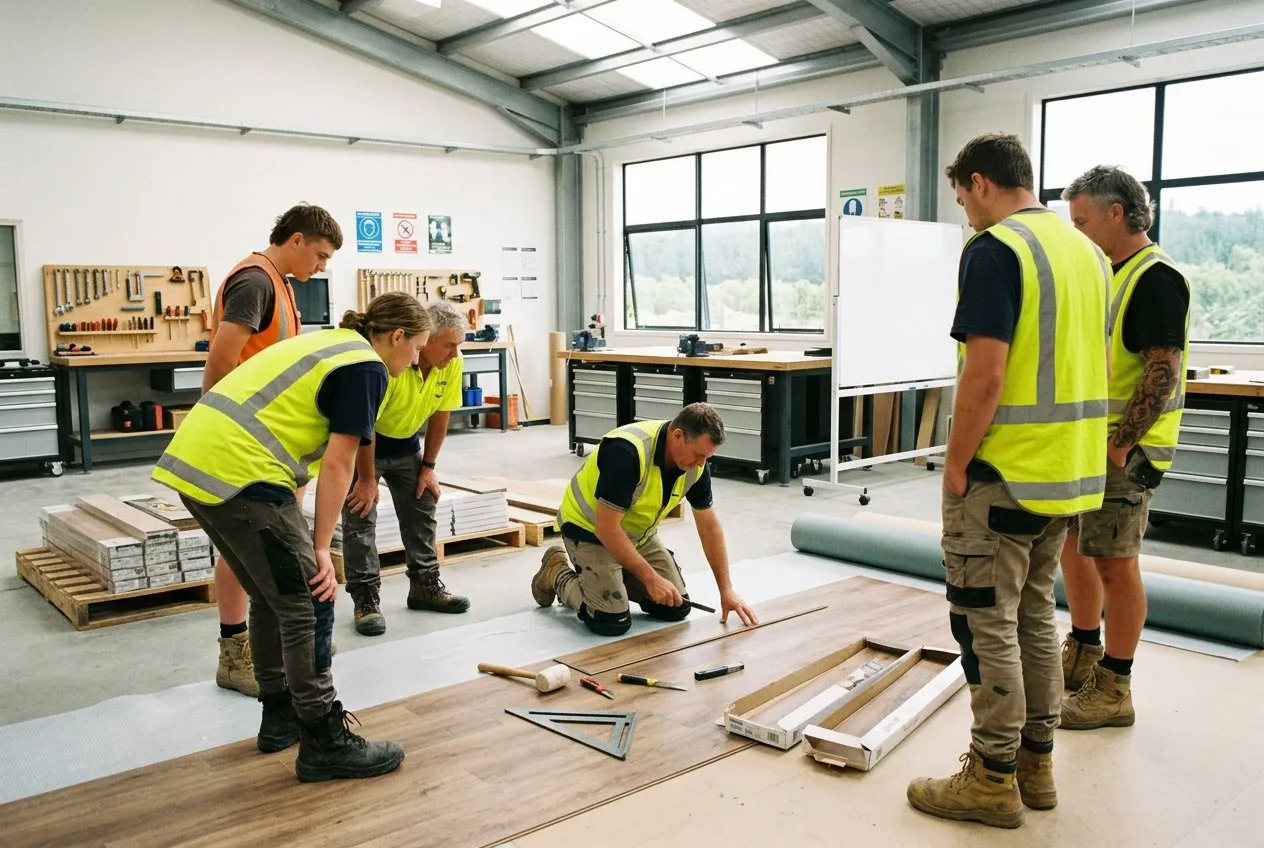
3. Training and qualifications. FloorNZ is an NZQA-registered private training establishment (PTE). The FloorNZ Training Academy is based in Christchurch, and FloorNZ also lists training centres in Auckland and Wellington. It delivers the block courses for BCITO flooring apprentices, along with pre-apprenticeship courses and upskill courses for people already working. (Flooring apprenticeships themselves are organised through BCITO. See our guide to flooring apprenticeships in NZ for how the pathway works.)
4. Networking and events. Regional network sessions (run in six centres in July 2025; FloorNZ told its May 2026 AGM it hopes to run them again late in 2026 alongside its Master Floorer launch), the annual Excellence in Flooring and BCITO Apprentice of the Year awards evening (held on 7 May 2026 in Auckland), and the AGM (28 May 2026).
What FloorNZ doesn’t do:
- It’s not a regulatory body. It doesn’t license installers, can’t stop you working and doesn’t set legal requirements.
- It’s not a guarantee scheme for consumers. Being a member doesn’t guarantee the quality of anyone’s work.
- It’s not a marketing channel. In our view, nobody should join expecting the member directory to fill their diary.
- It’s not an installer-only organisation. Retailers and suppliers are members too, and in our view their interests don’t always line up with installers’.
Membership categories and costs
FloorNZ publishes fixed annual fees rather than ranges. All prices exclude GST and are per calendar year:
| Membership type | Annual fee (+ GST) | Who it’s for |
|---|---|---|
| Student | Free | FloorNZ Training Academy learners while in training |
| Contract installer | $250 | Contract installers |
| Retailer (individual) | $550 | A single retail business |
| Retailer chain | $550 + $250 per extra store | The main business, plus each additional store |
| Manufacturer/supplier | $550 | Under $10m NZ flooring sales |
| Manufacturer/supplier | $1,500 | $10–30m NZ flooring sales |
| Manufacturer/supplier | $2,500 | Over $30m NZ flooring sales |
Check FloorNZ’s membership page before you join in case the fees have moved.
For a working independent installer, then, the cost is $250 + GST ($287.50 incl. GST) a year, about half a day’s charge-out at the lower day rates in our pricing guide, and closer to a quarter of a day for senior installers. Keep that in mind as you weigh up the rest.
What you actually get
These are the benefits FloorNZ publishes for members in 2026:
1. The Best Practice Guidelines. Updated guidelines for carpet and resilient floor coverings, for members only. In our view they’re most useful to newer installers and less so to senior installers who already know the trade inside out.
2. Cheaper training. Members pay less for FloorNZ Training Academy courses. Introduction to Flooring online, for example, is $200 + GST for members against $270 + GST for non-members. One-day upskill courses in Christchurch are $229 + GST per person for members against $329 + GST (each course needs at least six people to run). That’s a saving of about $70–$100 + GST per person, per course.
3. Insurance and ACC help. FloorNZ lists general insurance discounts with Tower Insurance (offered through 1Team in the FloorNZ app) and discounted ACC brokering reviews through Manage Group. It doesn’t list a group public liability scheme.
4. Member discounts. Fuel is 11c a litre cheaper at Mobil. Site Safe fees drop by 10%. And there are retail discounts through SpendSmart and 1Team/CSC.
5. Health and safety and business support. Health and safety services through Manage Group, and a “Profits and Cashflow” guide.
6. The FloorNZ app. Launched on 14 July 2026. It holds the Best Practice Guidelines and the member discounts, and members can register their waged or salaried staff on it.
7. Industry voice. When something affects the trade, FloorNZ lobbies government agencies for the industry. It’s hard to put a dollar figure on, but in our view it counts for something.
8. Directory and member sticker. FloorNZ’s website has a Find a Flooring Professional search. Ask to be listed when you join. You also get member stickers for your vehicle and building in the membership pack.
9. Networking. Regional sessions when they run, the awards evening and the AGM. In our view, these are often the only regular chance an independent installer gets to meet others in the trade and hear what’s going on outside their own circle.
10. Something to point to in a dispute. In our view, “I followed FloorNZ’s Best Practice Guidelines” carries more weight with a customer or builder than “I did it the way I thought was right.”
What you don’t get
A few things people sometimes expect from FloorNZ membership that it doesn’t deliver:
- A flow of customer leads. In our view, the directory listing is best treated as a bonus. If you’re joining for marketing, you’ll probably be disappointed.
- Enforcement on your behalf. FloorNZ isn’t a regulator, so it can’t make a customer or another business do anything.
- Automatic standing in the industry. In our view, membership shows you take the trade seriously, but it doesn’t replace experience or reputation.
Who it’s worth it for
In our view, membership pays its way for installers who:
- Actually take part. Go to regional sessions when they run, take courses at member rates and respond when FloorNZ asks for input. The value only turns up if you do.
- Work with retailers and builders who value it. Ask the ones you work with whether membership matters to them.
- Want published guidelines behind their work. That’s most useful on high-spec commercial jobs, council tenders and insurance-funded work.
- Want technical resources to keep learning, particularly newer installers.
- Want a say in industry policy. FloorNZ works with MBIE on building reforms and responds to consultations that affect flooring.
In our view, it’s probably not worth it for installers who:
- Work direct-to-customer only, with no retailer relationships and no interest in the industry beyond their own work.
- Are comfortable working below standard rates and don’t engage with the industry. (For a benchmark, see what NZ installers charge per m² and per day in 2026.)
- Have long experience and established networks that already give them what FloorNZ offers.
- Won’t go to events or use the resources. If you pay $250 + GST and don’t engage, you won’t get the value.
Where it sits politically
FloorNZ is a multi-stakeholder organisation. Retailers and suppliers are members alongside installers, and FloorNZ itself reported low installer membership in 2022. By 2025 it had 65 installer members out of 389.
In our view, that mix means its priorities won’t always match a solo installer’s. What suits a supplier or a multi-store retailer isn’t always what suits someone laying floors on their own. Most trade associations live with the same tension. It’s worth going in with your eyes open.
The honest verdict
In our view, FloorNZ membership is worth the $250 + GST a year for most working independent installers in NZ, if you actually use it.
The maths is simple. A one-day upskill course in Christchurch saves $100 + GST per person at member rates. Put three people through in a year (or one person through three courses) and you’ve saved $300 + GST, more than the $250 + GST fee. The guidelines, the fuel and Site Safe discounts and the sticker all come on top of that.
Pay and never engage? Then it’s a small waste of money. Either commit to using it or keep your money.
Retailers and suppliers face a different set of numbers. FloorNZ reports good membership coverage among retailers and suppliers. In our view, for them it’s more about standing in the industry than a direct return.
If you’re an independent trying to grow beyond solo work, membership is, in our view, one of the simpler steps you can take toward bigger clients and higher-spec jobs.
How to get the most out of membership if you join
A few ways to make the fee earn its keep:
1. Go to at least one event a year. A regional session (when they run), the awards evening or the AGM. In our view, networking is the most underused benefit.
2. Use the Best Practice Guidelines. Read them. Refer to them when a customer disputes your work. Cite them in your quotes.
3. Respond to consultations. When FloorNZ asks for industry input on regulation, training or guidelines, give it. That shapes what it advocates for, and people inside the organisation get to know your name.
4. Use the discounts. Book courses at member rates, use the Mobil fuel discount, and get the Tower insurance and Manage Group ACC reviews done. Those are where the fee comes back to you in cash.
5. Mention membership in your marketing. Put your FloorNZ membership on your van, and check with FloorNZ before using its logo on your website, cards and quotes.
What we’re tracking next
A few FloorNZ-related developments worth watching:
- Its position on marketplace platforms such as Builderscrack (hipages Group), and whether it pushes for installer-friendly platform terms
- How FloorNZ engages with Bremworth, now under a new controlling shareholder, after the failed Mohawk/Godfrey Hirst takeover. The Commerce Commission cleared the deal on 30 June 2026, shareholders blocked it in July, and the agreement was terminated on 7 September (see what happened to the Godfrey Hirst and Bremworth deal)
- How training develops now that BCITO has left Te Pūkenga and become an industry-owned PTE (1 January 2026), and how BCITO and the FloorNZ Training Academy split the work
- Any moves toward installer licensing. NZ has no flooring-specific licensing. The FloorNZ board formed a subcommittee on a Licensed or Registered Flooring Practitioner programme in 2024, and its Master Floorer Programme is listed as “coming soon”. FloorNZ expects to launch it near the end of 2026
We’re not affiliated with FloorNZ, paid by them, or advised by them. If you have direct member experience that contradicts what we’ve published (particularly on member benefits we’ve underrated or overrated), tell us through our contact form.
If you’re weighing the fee against your own numbers, our guide to working out your rates, margins and overheads as an installer runs through what to charge.
Methodology and sources
Checked 25 Oct 202626 sources
Checked on 25 October 2026. Fees, benefits and training details come from FloorNZ’s own published pages and newsletters. Underfoot has not surveyed FloorNZ members. Where we give a judgement rather than a fact, we say “in our view”.
Membership fees, benefits and the app (3)
Training (7)
Guidelines, advocacy, events and history (11)
- FloorNZ: technical flooring guidelines
- FloorNZ: best practice guidelines, resilient flooring, June 2019 (PDF)
- FloorNZ: AGM minutes, 28 May 2026 (PDF)
- FloorNZ: AGM papers, 28 May 2026 (PDF)
- FloorNZ: February 2024 newsletter, membership fees (PDF)
- FloorNZ: newsletter, December 2025
- FloorNZ: awards evening 2026
- FloorNZ: AGM 2019 (PDF)
- FloorNZ: July 2022 newsletter (PDF)
- FloorNZ: newsletter, July 2024 (PDF)
- FloorNZ: home page