Pricing is the single biggest unsolved problem for New Zealand flooring installers. Installers undercharge because they don’t know market rates. Retailers exploit that. Customers get conflicting quotes that make no sense. The whole market suffers from the lack of independent pricing data.
This piece is a credible 2026 benchmark — what NZ flooring installers should be charging for residential work, by category, by region, and by experience level.
Two ways installers price work
Installers in NZ use two pricing structures, and which you use shapes everything else:
1. Per square metre (m²) pricing. Most common for retailer-bundled work and standard installations. The installer gets a labour rate per m² laid, regardless of how long it takes.
2. Day rate pricing. More common for independent installers doing direct-to-homeowner work, complex jobs, or specialty work. The installer gets paid per day on site, regardless of how much area is laid.
Both have advantages. m² pricing rewards efficiency — fast installers earn more. Day rate pricing protects you on hard jobs — complex prep, irregular rooms, problem subfloors don’t punish you the way they do under m² rates.
Most experienced independent installers use a hybrid model: standard installations priced per m², complex work priced as day rate or with site-prep loadings.
Per-m² labour rates by category
These are the labour-only rates an installer should be charging in 2026 NZ — not the total installed price (which includes material).
| Product | Auckland | Wellington | Christchurch | Smaller centres |
|---|---|---|---|---|
| Carpet (stretch-in) | $32–$48/m² | $30–$44/m² | $28–$40/m² | $25–$38/m² |
| Carpet (direct-stick) | $35–$52/m² | $32–$48/m² | $30–$44/m² | $28–$42/m² |
| Vinyl plank (click-lock) | $35–$50/m² | $32–$46/m² | $30–$44/m² | $28–$42/m² |
| Vinyl plank (glue-down) | $45–$65/m² | $42–$60/m² | $40–$56/m² | $38–$52/m² |
| Hybrid (SPC, click-lock) | $38–$55/m² | $35–$50/m² | $32–$48/m² | $30–$45/m² |
| Sheet vinyl (welded seams) | $50–$75/m² | $48–$70/m² | $45–$65/m² | $42–$60/m² |
| Engineered timber (click-lock) | $45–$70/m² | $42–$65/m² | $40–$60/m² | $38–$56/m² |
| Engineered timber (glue-down) | $60–$95/m² | $58–$90/m² | $55–$85/m² | $52–$80/m² |
| Solid timber (nail-down) | $80–$120/m² | $75–$115/m² | $70–$110/m² | $65–$100/m² |
| Sand and finish (existing timber) | $60–$120/m² | $58–$110/m² | $55–$105/m² | $50–$100/m² |
The lower end of each range is for straightforward jobs — large rooms, simple cuts, accessible site, no problems. The higher end is for complex work — cuts around obstacles, multiple level changes, smaller rooms, renovation work where access is limited.
Day rates
For installers who price by the day:
| Experience level | Day rate (Auckland) | Day rate (other centres) |
|---|---|---|
| Apprentice (Year 1–2) | $280–$420 | $260–$380 |
| Apprentice (Year 3) | $360–$500 | $320–$460 |
| Qualified, 1–5 years | $480–$650 | $440–$600 |
| Qualified, 5–10 years | $600–$800 | $560–$750 |
| Senior installer / specialist | $750–$1,000+ | $700–$950+ |
These are what an installer should charge as a day rate when doing work directly. If you’re working through a retailer at a fixed m² rate, your effective day rate may be higher or lower depending on speed and job mix.
What goes into your m² rate
A fair labour rate for an installer needs to cover:
1. Direct labour cost. Your time, plus any apprentice or assistant time.
2. Tool and equipment depreciation. Stretchers, knee kickers, knives, saws, levels, moisture meters — all wear out and need replacing. Budget 5–10% of revenue.
3. Vehicle costs. Van, fuel, insurance, maintenance. Significant in NZ where most installers cover wide territories. Budget 8–15% of revenue.
4. Insurance and compliance. Public liability, professional indemnity (sometimes), GST, IRD, ACC. Budget 5–8% of revenue.
5. Time spent quoting and not paid. Many quotes don’t convert to jobs. The time spent measuring, quoting, and following up is real cost. Budget 10–15% of effective revenue (or 1 hour of unpaid quoting per 6 hours of paid install time).
6. Sick days, holidays, no-work days. You don’t get paid for days you don’t work. A working week of 5 days yields ~46 paid weeks per year (after public holidays, illness, weather, etc.).
7. Margin for capital and growth. Whatever you keep at the end — for tools, training, business development, savings.
A common mistake is calculating only direct labour and missing all the overheads. If you’re charging $30/m² thinking that’s $30/hour of work, but you spent 2 hours quoting that didn’t convert, plus tool maintenance, vehicle costs, and admin, your real recovery is closer to $18–$22/hour. That’s well below trade tradesperson rates and will eventually push you out of the trade.
Common pricing traps
1. The “do it for the relationship” trap. A retailer or builder asks for a low rate “just for this one” or “to get on our list.” You take it. Then they expect that rate forever, and renegotiation is harder than starting fairly. Price properly from day one.
2. The rush-job underpricing trap. Customer needs work fast; you quote quickly without thinking; you discover later the job has issues that would have been priced in if you’d taken time. Build a “rush premium” of 10–15% for short-notice work.
3. The Friday afternoon trap. Customer calls Friday wanting work next week. You quote at standard rates without thinking. You’re working a short week through public holiday season. Variable demand should be priced in.
4. The retailer subcontract trap. Retailer pays you per m² laid; they take the customer relationship; they decide which jobs you get. Their rate is competitive on its own but doesn’t account for the fact that you have no upside on a complex job (which they get paid for as overhead, not you). Independent direct customer relationships pay better.
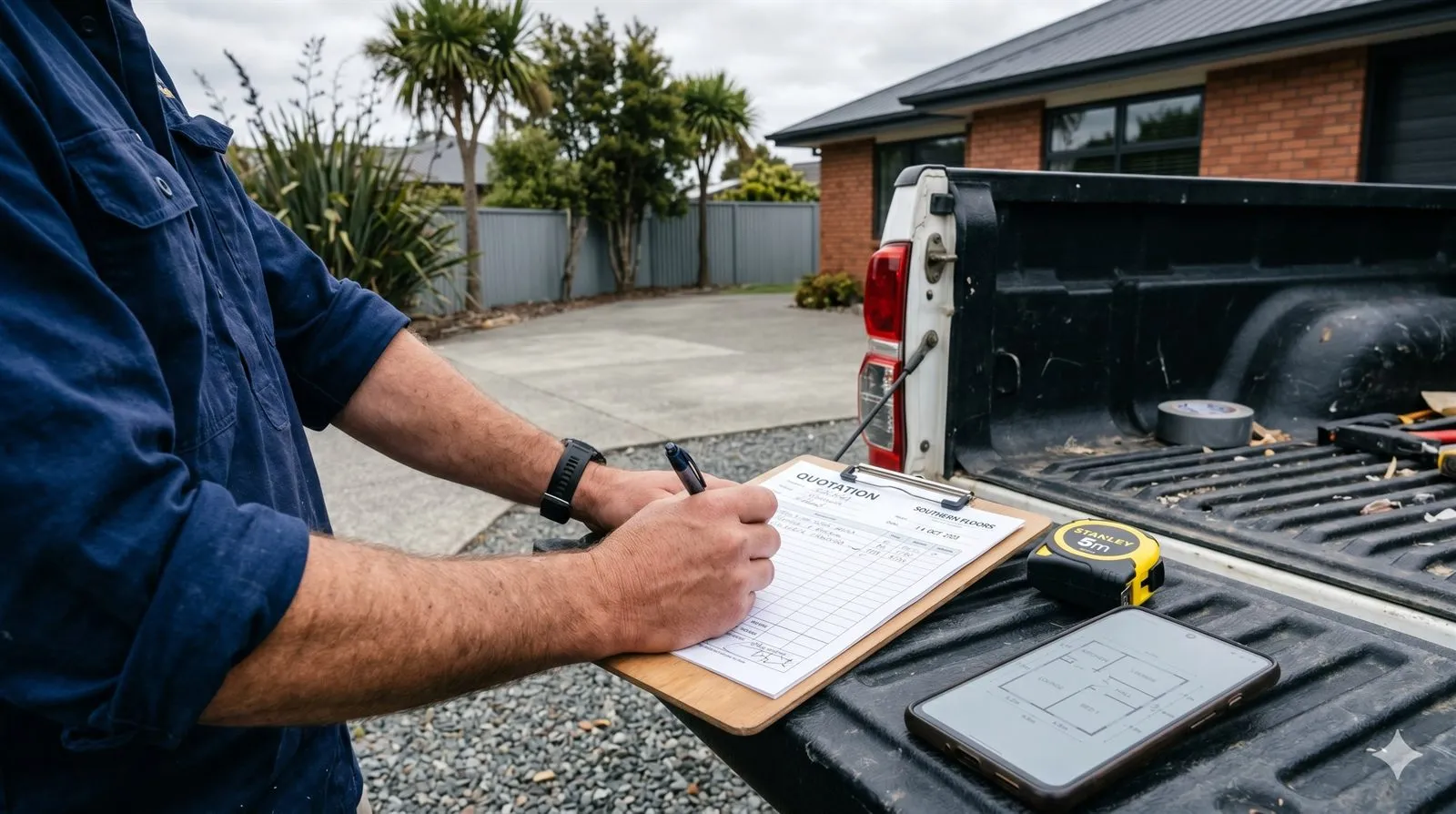
5. The no-quote-fee trap. Quoting takes time. If conversion rates are low, you’re losing money on quoting. Either build it into rates (conversion rate * effective rate must cover quoting time) or charge a quote fee for non-converting visits ($150–$250 typical, refunded if job proceeds).
Regional pricing reality
Auckland labour is genuinely 10–20% higher than other major centres. This is supply-and-demand: more demand, fewer qualified installers per capita.
Wellington labour is similar to Auckland for skilled trades, slightly less for general carpet work.
Christchurch and major South Island centres are typically the cheapest for labour, though premium installers in those markets price closer to North Island rates.
Smaller regional centres (Hamilton, Tauranga, Napier, Nelson) have less competition but also thinner job pipelines. Rates are lower than Auckland but utilisation is also lower — net income often similar.
If you’re moving regions or considering charging differently in different cities, the rule of thumb is: price to the local market while protecting your margin. Cheaper labour markets often have cheaper material supply too — overall margins can be similar.
What to charge for prep work
Subfloor prep is the most underpriced part of flooring installation. It’s also the most variable.
Self-levelling compound application: $30–$80/m² depending on depth and complexity. The compound itself is $15–$30/m²; the labour is the rest.
Moisture barrier installation: $8–$15/m² for materials and application.
Existing flooring uplift and disposal: $8–$20/m² depending on what’s coming up. Glued-down vinyl over concrete is the worst (can be $20–$30/m²).
Old skirting removal and reinstall: $15–$25/lineal metre for removal + reinstallation of existing skirting. New skirting is product cost on top.
Door undercutting: $35–$80 per door for under-cut to accommodate new floor height.
Furniture moving: $80–$200 per room for moving furniture and putting it back. Add for heavy items (pianos, large wardrobes).
These all need to be separately quoted line items. If you quote a single price that includes prep without specifying, you’ll either underprice (eating margin) or overprice (losing the job to a more transparent quote).
How to talk to customers about price
A few principles that help:
1. Itemise everything. Customers respect transparent pricing. Single-figure quotes feel like guesses; itemised quotes feel like value.
2. Explain the prep premium. “Your subfloor needs self-levelling because [specific reason]. That adds $X to the job. Skipping it means the floor will [specific problem] within [specific timeframe].” Concrete > vague.
3. Don’t apologise for fair prices. If your quote is higher than another, the difference is doing things right vs. cutting corners. Say so directly.
4. Build in revision points for surprises. “If we discover [specific issue type] during prep, we’ll talk to you before proceeding with [specific likely cost].” Sets expectations and protects you both.
5. Stand by your rate. Customers who try to negotiate down on day one will keep negotiating. Hold the line on price; offer scope flexibility instead (“we can do A or B for that price; for that lower price, we can do A only”).
What we’re seeing across the market
Installers we’ve talked to in 2025–2026 report:
- Demand is steady — slightly above pre-pandemic baseline, well below the 2021–2022 boom
- Material prices are normalising — supply chain volatility from 2022–2023 has eased, though wool carpet ranges are still erratic
- Labour scarcity remains real — particularly for hard flooring specialists in Auckland
- Retailer-bundled work is competitive at the bottom end — independent installers are winning on quality and direct customer relationships, not price
- Direct-to-consumer marketing is working — installers with a clear online presence (Google reviews, social, basic website) are getting steady direct enquiries
If you’re undercharging compared to the rates above, you’re probably being exploited by your retailer relationships or undervaluing your own work. If you’re overcharging compared to local market, you’ll lose volume — but possibly improve margin.
What we’d flag
The biggest pricing question for the next 12–24 months is how the marketplace platforms will affect direct pricing. Hipages and Builderscrack already extract rents from installers in subscription fees and commission models. Newer NZ-specific platforms may emerge.
Be cautious about platform models that promise volume in exchange for rate concessions. The volume often doesn’t materialise; the rate concession does.
We’re tracking platform developments and will publish analysis as they evolve. Subscribe at underfoot.co.nz/newsletter to be notified.
If you have pricing data — what you actually charge, regional variations we’ve missed, scenarios where these benchmarks are off — email us at hello@underfoot.co.nz. The more data we have, the sharper this benchmark becomes.