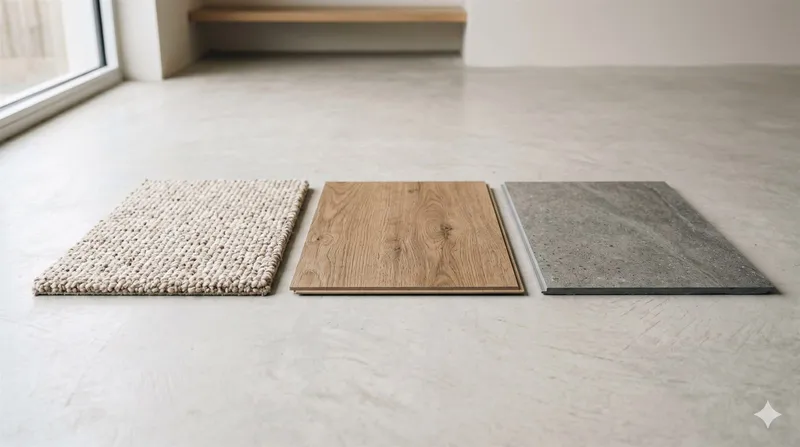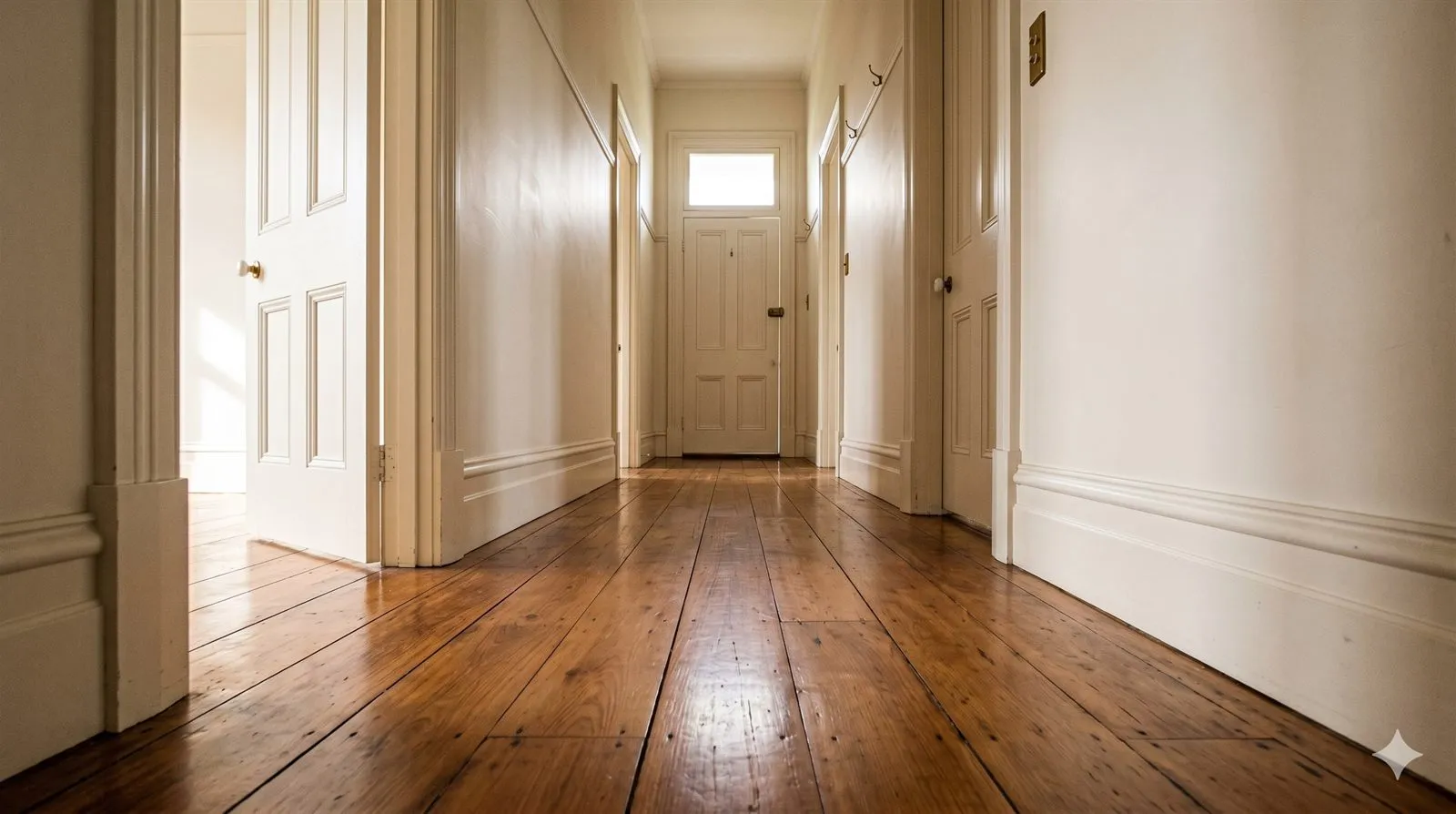
Auckland villas — broadly, the timber bay villas built between the 1880s and 1920s, plus the Edwardian-era variants that followed — have specific flooring challenges that don’t show up in generic buyer guides. The original kauri floorboards. The under-floor moisture problem. The uneven subfloor levels. The character considerations when you’re improving a heritage home.
This piece is the practical answer for Auckland villa owners working out what to do — whether you’re restoring, renovating, or just refreshing.
Start by looking down
Before considering any flooring choice, lift a corner of the existing carpet or vinyl in a quiet corner. What’s underneath is the most important variable.
Most Auckland villas were built with tongue-and-groove kauri or rimu floorboards on joists, often over a ventilated subfloor. After a hundred-plus years of life, those floorboards are usually one of:
- In good condition under existing covering — sound boards, minor surface marks, sometimes a few replacement boards. Restoration is the obvious move.
- Worn but salvageable — gaps, surface damage, some board damage, but the underlying timber is sound. Sand-and-finish job, possibly with selective board replacement.
- Damaged or unsalvageable — boards rotted from leaks, woodborer damage, structural movement. Need to assess whether to replace boards or cover.
- Already covered with sub-flooring — particle board, plywood, or hardboard laid over the original boards (often done in the 1970s–90s). Original kauri may or may not survive underneath.
If you have intact original timber, the first conversation should be with a heritage floor restoration specialist, not a flooring retailer. Restoration of 100-year-old kauri is usually the right answer for character living spaces. Costs run roughly $60–$120/m² for sand and finish, plus extras for board replacement or repairs.
What’s right for a typical Auckland villa floor plan
A typical Auckland villa has a hallway entry, two-to-four bedrooms off it, a lounge, often a separate dining room, kitchen, sometimes a bathroom. Modern renovations open up the back into kitchen-dining-living and add bathrooms.
Different rooms suit different products.
Hallway, lounge, dining (formal living spaces)
If you have intact kauri floorboards: restore them. Period homes with restored timber floors hold their value better and reflect the architecture. Cost is comparable to mid-range hybrid installation and the result is irreplaceable.
If you don’t have salvageable timber:
- Engineered oak ($150–$220/m² installed, mid-range) — looks appropriate to a villa, performs well, more dimensionally stable than solid timber for Auckland humidity
- Premium hybrid SPC with timber-look wear layer ($150–$200/m²) — cheaper, more durable, doesn’t fool a designer’s eye but is fine in everyday living
- Wool carpet ($150–$220/m²) — appropriate for villas if the family aesthetic suits, especially in formal lounges. Cheaper synthetic carpet usually undermines the room’s character.
What we’d avoid in formal villa living spaces: budget vinyl plank (looks plasticky against the period detailing), large-format tiles (wrong scale), bamboo (appropriate for villa-modern, jarring otherwise).
Bedrooms
Carpet — wool, wool-blend, or quality synthetic if budget tight. Bedrooms in Auckland villas are often the only insulated rooms; carpet matters here.
Specific recommendations:
- Solution-dyed nylon for kids’ rooms (stain resistance)
- Wool or wool-blend for adult bedrooms
- Plain or subtle texture — busy patterned carpet ages poorly and dates a room
Avoid hybrid or vinyl in bedrooms unless there’s a specific reason (allergies, pets, tenancy considerations).
Kitchen
In an open-plan villa renovation where kitchen flows into dining and living, continuous flooring matters visually. Hybrid SPC is usually the right call:
- Water-resistant for inevitable spills
- Continuous look across kitchen + living
- Durable for 20+ years
If you’ve got a separate kitchen and want a different floor: tiles are appropriate (cool, easy to clean, period-suitable in some villa renovations). Avoid vinyl plank in kitchens — it doesn’t hold up to standing water from a leaking dishwasher or a forgotten kitchen sink.
Bathrooms
Tiles. The only correct answer for a villa bathroom is tiles — porcelain, ceramic, or stone depending on budget. Hybrid is acceptable in a guest powder room with no shower; a full bathroom needs proper waterproofing under tile.
Hallway
Whatever you’ve chosen for the formal living spaces. Continuity matters in villas — long hallways with floor changes feel chopped up.
The moisture problem
Auckland villas are notorious for moisture issues under the floor. Common causes:
- Inadequate subfloor ventilation — original vents blocked, painted over, or removed during renovations
- Section drainage — water pooling near foundations from poor stormwater management
- Original timber on damp ground — many villas were built on land that’s wetter now than it was 120 years ago
If you have a moisture problem, fix it before laying any new flooring. New vinyl, hybrid, carpet, or timber will not solve a damp subfloor — they’ll trap the moisture and create worse problems.
A pre-renovation subfloor inspection should check:
- Ventilation (number, size, and clearance of subfloor vents)
- Moisture meter readings on existing timber
- Visible mould or damp patches
- Drainage around the foundation perimeter
Subfloor ventilation upgrades typically cost $1,500–$5,000 for a typical villa. If the cost worries you, do it anyway — flooring failures from moisture are more expensive to fix later.
Character vs. modernity
The hardest decision for villa owners isn’t which flooring product — it’s how much to honour the period vs. modernise.
A few principles that hold up:
Restored original timber elevates a villa. Few decisions add as much value to a period home as proper kauri or rimu floor restoration. If you have it, do it.
Wide-plank engineered oak reads as appropriate to a villa. Narrow modern strip flooring can feel wrong; wide-plank (180mm+) feels closer to original. This is true even if the original boards were narrower — wide oak reads as “appropriate to a heritage home” even where it’s not historically accurate.
Hybrid and vinyl plank with timber-look finish work in renovated areas. New extensions, modern kitchens, family rooms — modern materials are fine when the room itself is modern. Avoid trying to “fool” the eye in formal villa rooms; it usually doesn’t work.
Don’t mix too many timber tones. A hallway in oak, lounge in restored kauri, kitchen in hybrid plank — three different timber tones reads as chaotic. Pick a tone and run it.
Budget reality for typical villa flooring projects
For a typical 110–140m² Auckland villa, fully reflooring (excluding bathrooms, which need tiling work):
- Restored kauri throughout living + hybrid in kitchen + carpet in bedrooms: $14,000–$22,000
- Engineered oak throughout living/hallway + wool carpet in bedrooms: $20,000–$32,000
- Hybrid SPC throughout living/hallway/kitchen + synthetic carpet in bedrooms: $11,000–$18,000
- Carpet throughout (synthetic) + tiles in bathroom only: $8,500–$13,000
Add bathroom tiling at typical $300–$600/m² supplied and laid (small areas attract premium pricing).
These are working figures for a fully professional job, not budget ranges for taking shortcuts. If a quote comes in dramatically lower than the bottom of these ranges, ask what’s being skipped.
What we’d flag to villa owners
A few things that disappoint villa renovators that should be flagged early:
Sloping floors. Many Auckland villas have settled unevenly over a century. New floating floors (vinyl plank, hybrid) follow the existing slope; you’ll see it more clearly than under carpet. Self-levelling compound costs significant money for a problem that may have been invisible before.
Squeaks and movement. Original tongue-and-groove boards squeak. New floor coverings on top of them will still squeak. The fix is to address the boards (re-secure to joists), not to lay something on top.
Skirting and trim mismatches. Villas have characterful skirting. New flooring may need different transition trims than modern homes — and mismatched trims look bad in heritage rooms. Discuss this with your installer before they buy materials.
Asbestos in older covering. Vinyl floor coverings from the 1960s–80s can contain asbestos. If you’re removing existing vinyl, get it tested before disturbing it. Removal of asbestos-containing flooring requires a licensed remover and adds cost.
What to do next
If you’re at the planning stage:
- Lift the existing covering in a few spots to see what’s underneath
- Get a subfloor inspection before committing to any flooring choice
- Talk to a heritage floor restorer if you have intact timber — even just for an opinion on whether restoration is viable
- Get itemised quotes from at least two installers, including subfloor prep line items (see our cost guide)
We’re working on regional pieces for Wellington and Christchurch. Subscribe at underfoot.co.nz/newsletter to get those when they publish.
If you have an Auckland villa flooring story — what worked, what didn’t, what you’d do differently — email us at hello@underfoot.co.nz. Real-world cases inform our writing.