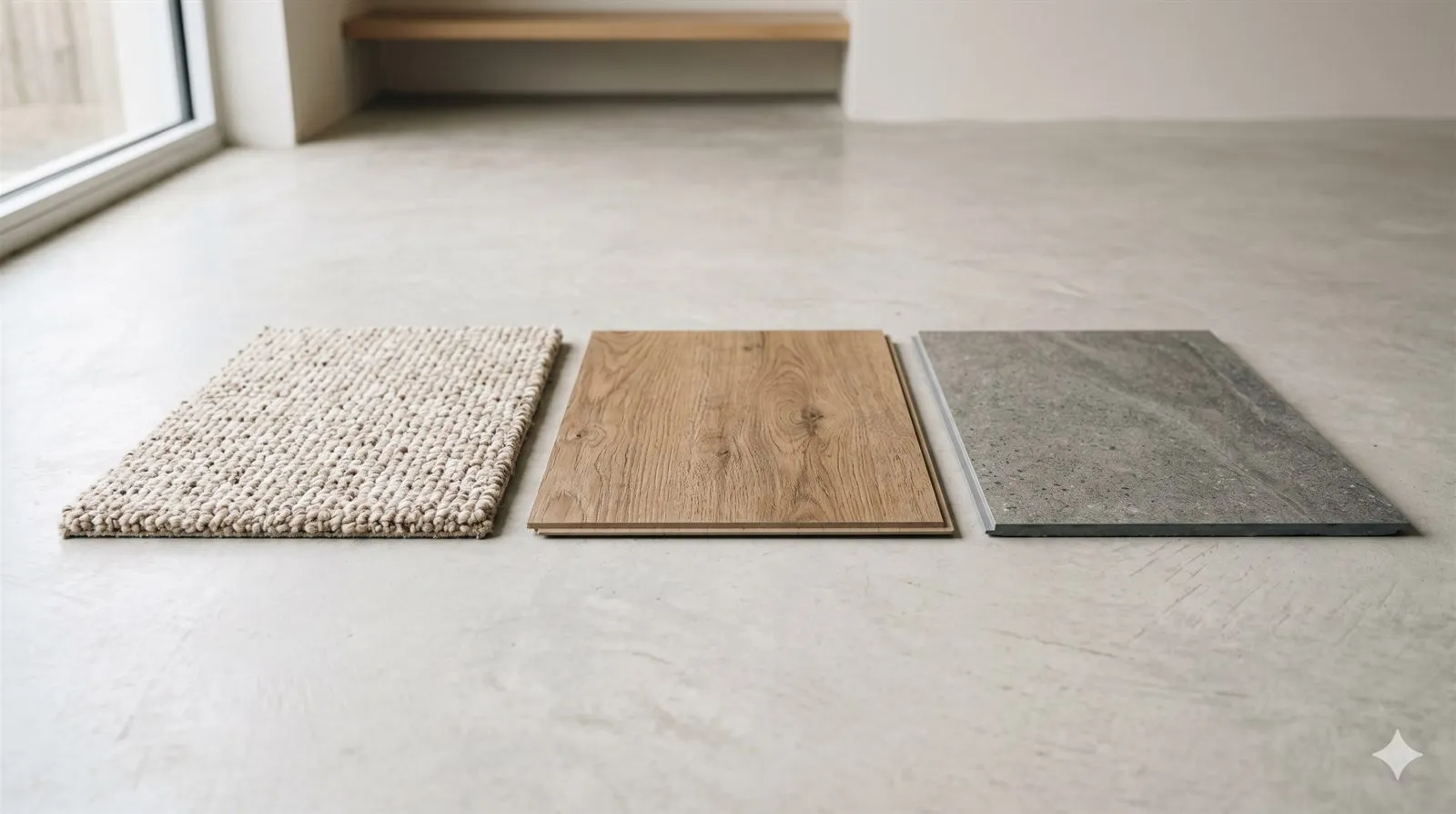
If you’re trying to choose between carpet, vinyl plank, and hybrid SPC flooring for a New Zealand home, you’ve probably noticed every retailer pitches the option they sell as the obvious answer. Carpet retailers tell you carpet is warm and quiet. Vinyl retailers tell you vinyl is durable and modern. Hybrid retailers tell you hybrid is the best of both worlds.
They’re all selling. Here’s the actual comparison.
TL;DR
- Carpet wins on comfort, sound absorption, and warmth. Loses on stains, allergens, and rooms with moisture risk.
- Vinyl plank wins on price, water resistance, and ease of installation. Loses on warmth and acoustic feel.
- Hybrid (SPC) wins on durability and stability. Loses on cost — typically the most expensive of the three for the comparable quality tier.
The right answer is almost always “different rooms get different flooring.” A blanket choice is rarely correct.
What each one actually is
Carpet is a textile floor covering — fibres tufted into a backing, laid over underlay, secured at edges. NZ market is dominated by synthetic options (solution-dyed nylon, polypropylene), with a smaller premium tier of wool and wool-blend products.
Vinyl plank (LVP / luxury vinyl plank) is a multi-layer synthetic plank — usually a wear layer over a printed design layer over a vinyl core, sometimes with a cushioned underlay. Click-lock or glue-down installation. Often marketed as “luxury vinyl” or “luxury vinyl plank.”
Hybrid (SPC — stone plastic composite) is a rigid-core engineered flooring product. The core is a mix of limestone and PVC, with a wear layer on top and an attached underlay below. Click-lock installation. Often marketed in NZ as “hybrid flooring” or “rigid core.”
These three products dominate the residential NZ market alongside laminate (a fourth category we’re not comparing here — broadly, laminate sits between vinyl and engineered hardwood in the trade-off space).
Cost
For a 100m² home, supplied and installed at 2026 NZ pricing:
| Product | Mid-range | Premium |
|---|---|---|
| Synthetic carpet | $50–$80/m² | $90–$140+/m² |
| Wool / wool-blend carpet | $60–$100/m² | $120–$190+/m² |
| Vinyl plank (LVP) | $75–$130/m² | $140–$200/m² |
| Hybrid (SPC) | $80–$120/m² | $130–$180/m² |
Across mid-range product, hybrid typically costs slightly more than vinyl plank, and synthetic carpet sits below both. Wool carpet sits at a clear premium over synthetic on a like-for-like quality tier, but is comparable in mid-range to LVP for a typical home.
These are installed prices, not the misleading “from $X” supply-only figures retailers use in advertising. See our cost guide for the full breakdown.
Durability and lifespan
Carpet: Synthetic carpet realistically lasts 8–15 years in residential use, depending on traffic and quality. Wool carpet can last 15–25 years if well-maintained. Carpet shows wear patterns in high-traffic zones (hallways, in front of the couch) — this isn’t damage, it’s normal flattening.
Vinyl plank: Quality LVP lasts 10–20 years residential. The wear layer is the durability variable — look for products with a 0.5mm+ wear layer for residential use. Cheaper LVP with thinner wear layers will scratch and fade noticeably within 5 years.
Hybrid (SPC): Realistically the most durable of the three. The rigid stone-composite core resists denting, indentation, and movement better than any other floating floor. 15–25 year lifespan is reasonable expectation. Click-lock joints are robust under normal residential traffic.
In rentals or homes with heavy pets, hybrid is the most forgiving. In quiet adult households, the difference between vinyl plank and hybrid is hard to notice in normal use.
Water resistance
This is where the three diverge most clearly.
Carpet: Avoid in any room with moisture risk. Bathrooms, laundries, kitchens with frequent spills — wrong product. Wet carpet must be dried within 24 hours or it grows mould. Repeated wetting will eventually require replacement.
Vinyl plank: Genuinely water-resistant on the surface, but standard click-lock LVP is not waterproof at the joints. Standing water that seeps between planks will get under the floor and cause issues. Better than carpet for kitchens and laundries, but not a perfect solution for bathrooms.
Hybrid (SPC): The rigid stone-composite core is genuinely waterproof in itself. Joint quality matters — premium hybrid products with mechanical click systems are rated for full bathroom use; budget hybrid is closer to LVP in joint performance.
For wet rooms (bathrooms, laundries) the two genuinely correct answers are tiles or premium-grade hybrid. For kitchens, hybrid or quality vinyl. For everywhere else, the moisture argument doesn’t really apply.
NZ climate considerations
New Zealand homes have particular climate challenges that affect flooring performance:
Humidity variation. NZ has high humidity in winter (especially Auckland and the upper North Island) and dry summers. This causes timber and laminate to expand and contract significantly. Vinyl, hybrid, and carpet are all dimensionally stable across humidity ranges. Solid timber and (to a lesser extent) engineered timber are more affected.
Older NZ houses with poor subfloor ventilation. Many pre-2000 NZ homes have moisture issues in the subfloor (concrete slab moisture, ventilation problems under timber floors). This affects all flooring above. A moisture barrier is non-negotiable, regardless of which product you choose.
Sun exposure / UV. NZ has high UV levels. North-facing rooms with large windows will fade carpet, vinyl, and hybrid over time. Wool carpet fades less than synthetic. Premium-grade hybrid with quality wear layer fades less than budget vinyl. This is a real factor for sunny living spaces — not a marketing point.
Cold climates (Wellington, southern South Island). Carpet provides genuine insulation value in unheated spaces. In a cold Wellington bungalow without underfloor heating, carpet feels warmer than hybrid by a meaningful margin. This isn’t marketing — it’s physics.
Comfort, acoustics, and feel
This is where carpet wins, period. There’s no synthetic plank product that approximates the feel of carpet underfoot, the sound absorption of a carpeted room, or the thermal warmth.
For bedrooms, lounges, and quieter living spaces in adult households without pets, carpet is genuinely the better experience. For high-traffic, multi-use, family-with-kids-and-pets spaces, the maintenance burden often makes hard flooring the better trade.
Hybrid and vinyl can be softened with quality underlays and area rugs, but the base experience is hard.
Allergies, mould, and dust
Carpet harbours dust, dust mites, and pet dander. For allergy-prone households, hard flooring is the medical recommendation. Wool carpet is naturally more resistant to dust mite issues than synthetic — but still worse than hard flooring on this dimension.
For mould-prone homes (poor ventilation, persistent humidity, leak history), hard flooring is the safer choice in any room with risk.
Real-world recommendations for typical NZ homes
An Auckland villa with three bedrooms, kitchen, lounge, dining, two bathrooms, two toilets:
- Bedrooms: wool or wool-blend carpet (warm, quiet)
- Lounge / dining: hybrid or quality engineered timber (durability + entertaining)
- Kitchen: hybrid (water resistance for the inevitable spills)
- Bathrooms / toilets: tiles
- Hallway: hybrid or carpet, depending on visual continuity preference
A Wellington bungalow, two bedrooms, one bathroom, open-plan living:
- Bedrooms: carpet (insulation matters in cold rooms)
- Open-plan living: vinyl plank (cost-efficient, easy to clean)
- Bathroom: tiles
- Hallway: vinyl plank (visual flow)
An Auckland rental, two bedrooms, kitchen, lounge:
- All: hybrid SPC throughout (most forgiving for tenants, easiest cleaning, longest replacement cycle)
- Bathroom: tiles or hybrid
A new-build, three bedrooms, two living spaces, kitchen, two bathrooms:
- Bedrooms: wool carpet
- Living spaces: hybrid or engineered timber (depending on budget)
- Kitchen: hybrid
- Bathrooms: tiles
- Entry: hybrid (durability for foot traffic and water from outdoors)
What retailers won’t tell you
A few practical things that don’t show up in any retailer pitch:
Hybrid and vinyl planks expand and contract. All click-lock floating floors need expansion gaps at the perimeter (10mm typical). If your installer doesn’t leave them, the floor will buckle. This isn’t a manufacturing defect — it’s an installation failure.
Carpet seam visibility depends on installation skill. A good carpet installer makes seams nearly invisible. A poor one creates visible lines for the life of the carpet. The product matters less than the person fitting it. See our upcoming guide on finding good installers.
Manufacturer warranties are often less impressive than they sound. “25-year warranty” on synthetic carpet typically excludes wear, fading, traffic patterns, and most things that actually go wrong. Read warranty fine print before letting it influence your decision.
Resale value impact varies. Hybrid and engineered timber generally support higher home valuations than vinyl plank. Carpet is neutral. Cheap vinyl plank can actually hurt resale if visibly low-quality.
The honest summary
For most NZ homes, the right answer involves carpet in bedrooms, hybrid or vinyl in main living areas, and tiles in wet rooms. A blanket choice across the whole home is almost always sub-optimal — except in rentals, where hybrid throughout is the right operational call.
Cost-conscious: vinyl plank in living areas, synthetic carpet in bedrooms.
Quality-conscious: hybrid or engineered timber in living areas, wool carpet in bedrooms.
Operationally focused (rental, family with kids and pets, easy cleaning priority): hybrid throughout.
Don’t let a retailer pitch you a single product across the whole house. The right answer respects the different uses of each room.
What to do next
We’re working on regional pieces — Best flooring for Auckland villas, Choosing flooring for Wellington rentals, Hybrid vs engineered timber for new builds — that go deeper into specific scenarios. Subscribe at underfoot.co.nz/newsletter to get those when they publish.
If you have a specific scenario you’d like us to cover or you’ve spotted something missing or incorrect in this comparison, email us at hello@underfoot.co.nz. We update our buyer guides as readers send better information.