SPC flooring explained: what it is, and what to check before you buy in NZ
SPC flooring explained for NZ homeowners: what it is, how it differs from vinyl plank and laminate, waterproof limits at joints, wear layers, sun and E3.
Checked November 2026.
SPC (stone plastic composite) flooring is a rigid vinyl plank with a core made mostly of limestone and PVC. In New Zealand it’s usually sold as “hybrid” or “rigid core” flooring, and it’s laid as a floating floor: the planks click together and sit on the subfloor (the concrete slab or timber floor underneath) without glue or nails. The plank itself resists water. What the “waterproof” label won’t tell you is how the joints and edges cope with water, and the box may not separate the wear layer (the clear protective layer on top) from the total thickness. Those are the two things to check first.
Is it any good?
- Good for: spills and mopping, because the plank itself doesn’t absorb water. It floats, so no glue. You get timber or stone looks, and the underlay often comes attached.
- Watch for: joints and edges that aren’t watertight, the need for a flat subfloor and expansion gaps, makers’ limits on sun and heat, apartment noise rules, and warranties that are often pro rata (the cover shrinks each year).
- Cost: about $80–$120/m² supplied and installed in the mid-range (see our hybrid flooring price breakdown).
What is SPC flooring, and what is hybrid flooring?
SPC stands for stone plastic composite. One NZ importer describes it as “a rigid vinyl made from limestone and PVC”, and Ecodure, which sells rigid core flooring in NZ, says the limestone content of a rigid core product can be more than 70%. The planks join with a click-lock edge rather than glue.
On quotes and showroom signs you’ll mostly see “rigid core” and “hybrid”, and makers use both names. Karndean’s installation guides say “Rigid core/hybrid flooring”. Godfrey Hirst’s NZ instructions call its product “hybrid” and require a floating installation, because the planks “need to be able to move”.
SPC vs hybrid flooring
Usually the same thing, but not always. “Hybrid” is a sales name, and we found no NZ standard that defines it. Most of the time it means SPC or a similar rigid core plank, but some rigid cores are WPC (wood plastic composite) or other composites, so read the spec sheet.
What’s inside an SPC plank
An SPC plank is a stack of layers. An environmental product declaration (EPD, a manufacturer’s declaration of what a product is made of and its impacts) published through the International EPD System lists them, top to bottom:
- a final UV coating
- a clear PVC wear layer, embossed for texture
- a printed décor film, which gives the timber or stone look
- the rigid core (the EPD calls it the substrate), made mainly of PVC and calcium carbonate (the main mineral in limestone), plus additives such as lubricants and stabilisers
- sometimes a backing, such as IXPE foam, for acoustic performance and comfort
Ecodure’s hybrid guide lists cork, EVA or IXPE as the usual attached underlays (IXPE and EVA are foams).
SPC vs vinyl plank (LVP and LVT) vs laminate
LVP is luxury vinyl plank and LVT is luxury vinyl tile. Here’s how the four floors you’ll often see side by side in a showroom differ.
| SPC / rigid core (hybrid) | Vinyl plank or tile (LVP, LVT) | Sheet vinyl | Laminate | |
|---|---|---|---|---|
| Core | Limestone and PVC | Vinyl, without the rigid core | Vinyl, in one sheet | High-density fibreboard (HDF) |
| How it’s laid | Floating, click-lock | Click-lock (floating) or glue-down | Rolled out as a sheet | Check the maker’s instructions |
| Water | Plank resists water; most click joints aren’t watertight. Some products have E3 documents: ask for one and its conditions | Plank resists water; joints aren’t watertight | No joints across the sheet | Check the maker’s wet-area rules |
| Typical thickness | About 4–8 mm overall | - | - | About 8–12 mm |
| How wear is rated | Wear layer in mm; ISO 10874 use class (explained below) | Wear layer in mm; ISO 10874 use class | - | AC rating (EN 13329) |
Thicknesses are from NZ sellers’ guides. The water row draws on Tradie Tools, which says “The planks themselves don’t absorb water” and calls sheet vinyl “completely waterproof with no joints”.
LVP vs SPC
The difference is the core and how it’s laid. LVP can float (click-lock) or be glued down to a smooth, dry, level subfloor. Hybrid is usually SPC: a vinyl plank on a rigid core, laid floating and usually with underlay attached. It generally costs a little more than vinyl plank.
Is hybrid flooring better than laminate?
For water, hybrid has the edge: its plank doesn’t absorb water, while laminate has an HDF core, so check the laminate maker’s wet-area rules. For budget, laminate usually wins, at about $55–$80/m² installed mid-range against $80–$120/m² for hybrid. Wear is rated differently too: the AC scale (EN 13329) for laminate, wear layer thickness for SPC. Our laminate vs hybrid guide goes room by room, and our guide to the main types of flooring in NZ sets both against the other options.
Is SPC flooring waterproof? The plank vs the floor
Yes for spills and mopping. No for water that sits, such as a leak or a flood. The plank resists water; the joints and edges are where it can fail. Picture a washing machine or dishwasher hose leaking slowly behind the appliance. The water pools, and that’s where the joints matter: as Tradie Tools says, “joints between planks are not watertight”.
Strata’s website says “Hybrid flooring is 100% waterproof, even when water sits on the surface for long periods”. Ecodure’s guide says hybrid and vinyl are “100% waterproof” and that hybrid “can be installed in every room of the home”, including kitchens, bathrooms and laundries. Those are their words, not ours.
Now read what two makers put in their installation instructions:
- Godfrey Hirst (NZ instructions, August 2025): “Although Godfrey Hirst hybrid flooring is impervious to moisture, it should not be installed in areas that have a continual risk of excessive moisture/flooding such as saunas or outdoor areas.”
- Karndean (ANZ rigid core guide, August 2023): the plank “will not absorb, swell or be damaged by water” and is “suitable for use in traditional residential bathrooms, kitchens, laundry/utility rooms”, but it is “not suitable for installation outdoors nor in rooms that will be continually wet”. Its care notes also say not to leave standing water on the floor, because of the slip risk.
So the plank itself resists water: Godfrey Hirst calls its plank “impervious to moisture” and Karndean says its plank “will not absorb, swell or be damaged by water”. For the finished floor, the installation instructions we read are narrower: they exclude continually wet areas and set conditions for wet areas.
The edges: sealing rules differ by maker
A floating floor needs an expansion gap around the edge so it can move. Godfrey Hirst asks for at least 10 mm at every fixed vertical surface, including cabinetry and island benches, and says silicone or caulking compound “should not be used” in that gap. Its wet-area conditions (below), though, call for bathroom-grade soft silicone around the perimeter.
Karndean allows a flexible acrylic or low-modulus neutral-cure silicone sealant in the gap in potential wet areas. It says sealant “should not be used for the general filling of expansion gaps” and that the wet area should be isolated from the main floor by an expansion joint at door junctions. It also gives a maximum net sealed area of 4 m², “as a guide”. Follow the instructions for the exact product going down.
Is SPC suitable for a kitchen, bathroom or laundry? What E3 says
Room by room:
- Living areas and bedrooms: fine.
- Kitchen: yes, but ask for the maker’s E3 document first.
- Laundry and bathroom: only if the maker’s wet-area conditions fit your room.
E3 is the Building Code clause on internal moisture. E3.3.3 says: “Floor surfaces of any space containing sanitary fixtures or sanitary appliances must be impervious and easily cleaned.” The current Acceptable Solution, E3/AS1 (amendment 7), notes this applies “to spaces such as kitchens, bathrooms, laundries and toilet facilities”.
An Acceptable Solution is a set of methods already accepted as meeting the Code. According to BRANZ’s Level website (last updated 30 January 2026), E3/AS1 lists three wet-area floor finishes:
- waterproof sheet material, such as PVC, with sealed joints and sealed or coved edges (coved means curved up the wall)
- ceramic or stone tiles, with 6% maximum water absorption and waterproof grouted joints
- a sealed slab-on-grade concrete floor with a steel-trowel or polished finish, but only in a domestic laundry in a garage or a building that contains only sanitary facilities
Level adds that “Other floor finishes may also satisfy performance requirements, but they are outside the scope of the Acceptable Solution” and “must be consented as an Alternative Solution”. Its quick reference has no entry for click or hybrid vinyl plank.
So a click floor in a wet area relies on an Alternative Solution: a way of meeting the Building Code that sits outside the Acceptable Solution and needs its own evidence, such as the maker’s technical documents or an appraisal, which the council assesses if consent is needed. Some hybrids carry E3 compliance statements (Neptune’s E3/AS1 alternative solution statement is one), but one product’s statement doesn’t cover another. Don’t treat a product as E3 compliant until you’ve checked the maker’s document against your room.
Replacing a floor finish in an existing home doesn’t need a building consent (Schedule 1, exemption 12), but the work still has to meet the Building Code, including E3. Our explainer on the Building Amendment Bill and floor work covers the exemption.
What one maker’s wet-area conditions look like
Godfrey Hirst’s NZ wet-area section covers only its Metropol range and only “Category 3” wet areas under the Australian standard AS 3740:2021, such as a bathroom without a shower or a powder room. There must be no floor waste (floor drain), the total wet area must be under 8 m², and the perimeter must be sealed with bathroom-grade soft silicone. The section cites the Australian building code (the BCA) and AS 3740, not the NZ Building Code, so for any hybrid in a bathroom or laundry, ask for its NZ Building Code E3 documentation. Conditions like these can rule out rooms, floor drains and areas over a set size.
If your house has consent drawings
One NZ importer’s SPC installation page says that where consent drawings specify tiles, vinyl or similar, substituting laminate, SPC or other flooring “requires a Minor Variation approved by Council before installation”. Check with your council before you order.
Is SPC suitable for a kitchen?
Yes. Karndean, for one, calls its plank suitable for residential kitchens. E3’s impervious, easy-clean floor rule still covers kitchens, so ask for the product’s E3 document and conditions, and the gap it needs around cabinetry and island benches (Godfrey Hirst asks for 10 mm). Our vinyl and hybrid cost guide covers what wet areas do to a quote.
Wear layer, thickness and ratings: how to read an SPC spec sheet
SPC spec sheets carry three numbers that get mixed up, and each measures something different.
Wear layer. The clear layer under the UV coating that takes the scuffs. Tradie Tools gives these bands for luxury vinyl (LVT): about 0.2–0.3 mm for entry-level, 0.3–0.5 mm mid-range, and 0.5–0.7 mm+ for premium. Some spec sheets give it in mil, an imperial unit, so ask for millimetres.
Total thickness. About 4 mm to 8 mm for SPC, according to one NZ supplier’s thickness guide. That’s the full build-up, and it often includes any attached acoustic backing. The wear layer is measured separately.
Use class. ISO 10874 sets use classes by the area and intensity of use: 21–23 domestic (moderate, general, heavy), 31–34 commercial, and 41–43 light industrial. One example from Belgotex’s LVT brochure: Primero II, with a 0.3 mm wear layer, is rated Class 23 (domestic, heavy) with a 20-year residential warranty. It’s a glue-down vinyl tile, not SPC, but it shows how a use class appears on a spec sheet.
Does a thicker plank mean a tougher floor?
Not necessarily. One NZ importer lists a 6.5 mm SPC plank with a 0.3 mm wear layer, marked “residential use only”, with a 10-year pro rata warranty and built-in underlay. Total thickness often includes the backing, so two planks of the same thickness can have very different wear layers.
What about AC ratings?
AC (abrasion class) ratings come from EN 13329, the European standard for laminate. EN 16511, the European standard for click-together floors “designed for floating installation” such as SPC, explicitly excludes laminate covered by EN 13329. So if a vinyl plank carries a label such as “AC3”, ask which standard it was tested to.
At least one NZ SPC warranty card doesn’t count gloss reduction as wear, so a floor that has lost its sheen may not be covered.
SPC in apartments: noise, and does hybrid flooring need underlay?
Usually not, because it already has one. Many SPC planks come with an attached underlay, and a second one may not be allowed, so don’t add one unless the maker approves. Godfrey Hirst asks for a plastic sheet over rough subfloors such as chipboard, so the backing doesn’t catch.
Noise is the bigger question in an apartment. Building Code clause G6 sets minimum sound insulation between household units, and a body corporate can set operational rules: one flooring retailer notes those rules “commonly require written approval before a hard floor replaces carpet”. The steps, and the one acoustic underlay price we could find, are in our cost guide’s section on apartments: noise rules, approval and acoustic underlay.
Sun, heat and underfloor heating
Karndean is direct about sun and heat. Its ANZ rigid core guide says the product “should be protected from heat and/or prolonged exposure to direct sunlight as this may cause damage to your floor”. It asks for a minimum 10 mm expansion gap in “unheated rooms, sunrooms/conservatories or direct sun through glass doors”, against 5 mm normally and 8 mm for areas over 100 m².
NZ sun is strong: NIWA says peak UV here is “approximately 40% greater than at comparable latitudes in the Northern Hemisphere”. But the UV index is weighted to the UV that burns skin, so it isn’t a measure of what fades or heats a floor, and we found no study of SPC fading or heat movement in NZ. In our view, sunrooms, conservatories and rooms with big north-facing glass are where to ask about extra gaps before you buy.
Can SPC go over underfloor heating?
It depends on the maker, and the rules differ a lot:
- Godfrey Hirst: never over an electrical radiant heating system. Hydronic (hot-water) heating is allowed if it’s properly installed.
- Karndean: allowed if the temperature where the backing meets the subfloor stays at no more than 27 °C, with no localised hot spots. Mesh or wire systems must be bedded in levelling compound. Check with the heating maker that an electric system is compatible.
How to install hybrid flooring: floating, flat and free to move
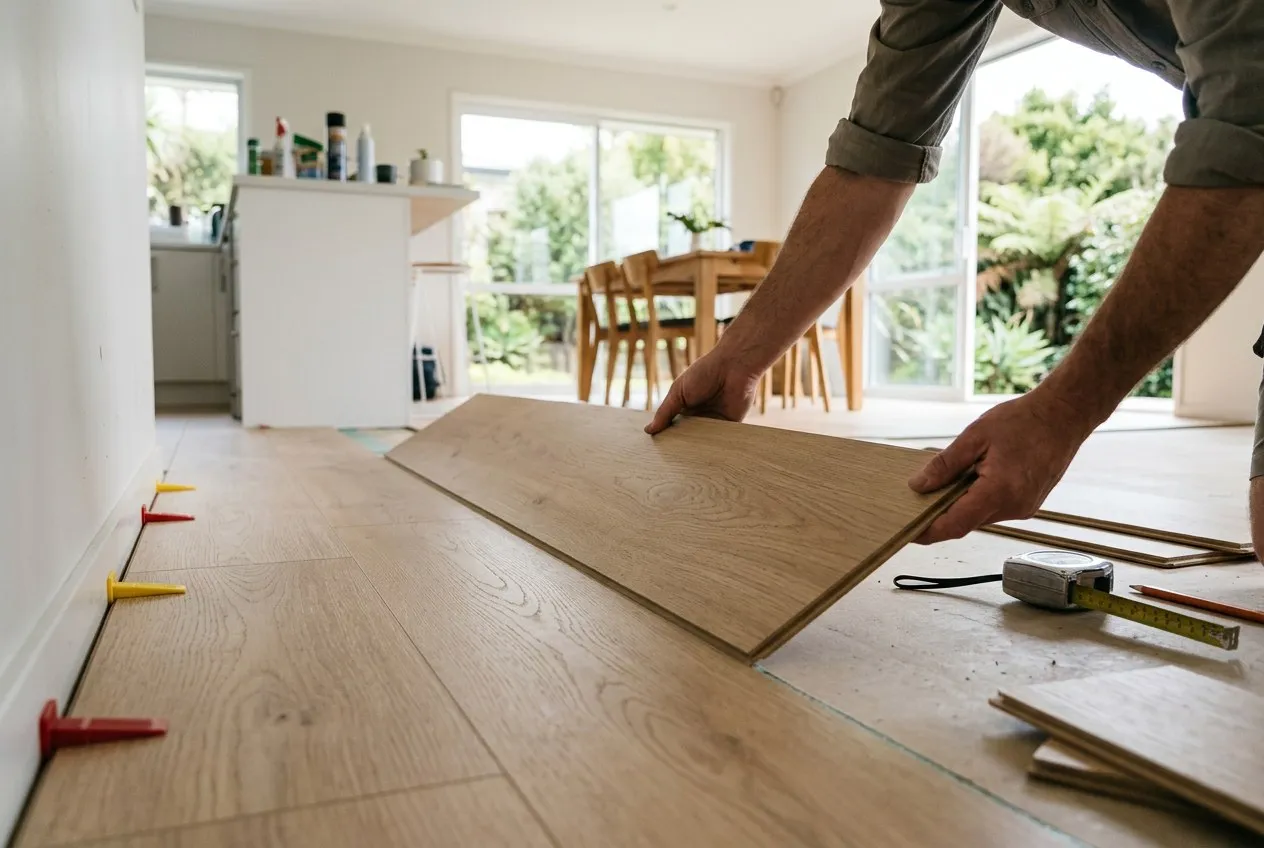
SPC floats. The planks lock to each other and the floor rests on the subfloor, free to move. That’s why Godfrey Hirst says floor-mounted door stops, sliding door runners, wardrobe tracks and bi-fold rails must never be fixed through the floor, and that furniture over 200 kg shouldn’t be placed on it.
The subfloor has to be flat and dry. Godfrey Hirst warns that uneven subfloors “can cause the locking system to break”, and wants moisture measured to AS 1884 and the readings recorded. If the subfloor isn’t tested, it asks for a continuous damp-proof membrane: a 200 micron plastic sheet, overlapped and taped, or a liquid membrane.
Levelling, and the asbestos checks to do before lifting old vinyl, are covered in our cost guide’s section on subfloor prep and the cost to level a floor. For an older house, our guide to flooring for Auckland villas covers subfloor moisture.
Does hybrid flooring expand?
Yes. Godfrey Hirst warns that insufficient gaps “may cause buckling, peaking, cupping and/or separation”, and Karndean asks for a bigger gap in sunrooms, unheated rooms and where there’s direct sun through glass doors. So don’t believe anyone who says SPC doesn’t move.
What the makers’ instructions say
The numbers change from one document to the next, and none is the “right” one for every floor. Here are two of them, expansion gap and flatness, from three documents. Use your own product’s instructions.
| Godfrey Hirst NZ (Aug 2025) | Karndean ANZ rigid core (Aug 2023) | One NZ importer’s SPC guide | |
|---|---|---|---|
| Expansion gap | At least 10 mm at fixed vertical surfaces | 5 mm; 8 mm over 100 m²; 10 mm in sunrooms, unheated rooms, sun through glass | 6 mm |
| Flatness | 2 mm over 1,000 mm | Max 5 mm below level over 3 m | 3 mm over 3 m (warranty card: ±3 mm over 1.5 m) |
Moisture limits and maximum run lengths differ between these documents too. The importer’s installation guide and its warranty card give different flatness limits, so ask which one applies.
Who should lay it
Godfrey Hirst “recommends installation be carried out by a professional flooring installer”. Doing it yourself means meeting the same requirements: a subfloor checked for flatness and moisture, the right gaps, nothing fixed through the floor, and dust control. Godfrey Hirst says that if the planks are sawn, dust extraction and/or respiratory protection must be used. Our health and safety guide for flooring jobs covers dust and asbestos, and what happens on installation day walks through the job from quote to finish.
How long does SPC last, and what do warranties cover?
Nobody can give you a fixed number, and the ranges below are estimates, not measurements. Tradie Tools’ figures are for luxury vinyl and tie lifespan to the wear layer: for entry-level (0.2 mm), 5–10 years in residential use before wear becomes visible; for mid-range (0.3–0.5 mm), 10–20 years; and for premium (0.55 mm+), 20–30 years “with warranty”. For hybrid, the figures come from businesses, not independent tests: Ecodure says most quality hybrid products carry 15–25 year warranties, and one Auckland property maintenance company publishes its own estimate of a 15–20 year lifespan.
Warranties: read the conditions
In our view the terms matter more than the number of years. Look for three things:
- Pro rata cover. One NZ importer’s SPC warranty card says coverage “decreases over time”, and a table on the card shows the share of material value covered in each year. You pay for removal, labour, freight, disposal and installation, and the warranty is for the original purchaser only.
- Conditions you have to meet. Both of that importer’s warranty cards make cover conditional on following its installation and care instructions. Godfrey Hirst also ties its warranty to following its care and maintenance guidelines. The importer’s older card excludes board separation and damage from direct sunlight and water.
- “Lifetime”. It means whatever the maker says. One Australian maker’s hybrid care and warranty guide, marketed in NZ, defines its Residential Lifetime Warranty as 35 years, covering premature wear and manufacturing defects. Its own depreciation table reaches 0% from year 31.
Your rights under the Consumer Guarantees Act
A warranty sits on top of your legal rights. It doesn’t replace them. Consumer Protection says products must be fit for purpose and of “acceptable quality”, which the page explains as “safe, durable, free from defects, and last a reasonable time”. The Consumer Guarantees Act applies “regardless of any store warranty or guarantee”, and businesses can’t limit their obligations to a store or manufacturer’s warranty. The page sets no fixed time limit for “a reasonable time”.
PVC flooring and the environment: what we can and can’t say
SPC is a PVC flooring. Building Performance (MBIE), in its “Materials inside your home” guide, says VOCs (volatile organic compounds, chemicals that evaporate into indoor air) from materials and furnishings are a major source of indoor air pollution, and are commonly found in vinyl flooring, among other products. It also says recycling PVC “can be limited in New Zealand, especially if it is blended with other compounds”.
An OECD report (2021) says “plastic flooring is not typically reused or recycled today”, and landfill and incineration are the most common ends of life. The report covers vinyl sheet and tile, WPC and PET flooring, so its findings aren’t specific to SPC. We found no NZ-specific data on SPC recycling or emissions. If either matters to you, ask for the product’s EPD or emissions data, and read it as the maker’s declaration.
How to compare SPC products before you buy
Ask for these for each product on your shortlist, in writing where you can.
| Ask for | Why |
|---|---|
| Wear layer in mm, and total thickness separately | They measure different things |
| Use class (ISO 10874), and the test standard behind any rating | AC is a laminate scale; ask which standard any rating used |
| The maker’s NZ installation instructions for that exact product | Gaps, flatness, moisture and run lengths differ by maker |
| Whether the underlay is attached, and whether a second one is allowed | Avoids doubling up |
| An E3 document, if it’s going in a kitchen, laundry or bathroom, and its conditions | Conditions can rule out rooms, floor drains or areas over a set size |
| Underfloor heating and sun or conservatory limits | They vary by maker |
| Warranty: pro rata or not, what it excludes, who pays for labour | Pro rata cover drops each year |
| EPD or emissions data, if it matters to you | It’s the maker’s own declaration |
In our view, a supplier who can’t produce the installation instructions for the exact product has told you something.
What to do next
On price: hybrid or SPC costs about $80–$120/m² supplied and installed in the mid-range, and $130–$180/m² for premium. Prep, removal of the old floor, trims and acoustic underlay come on top. Our vinyl and hybrid flooring cost guide breaks them down, and our all-floors cost guide covers carpet, laminate and timber too.
- Shortlist products by their documents, not their names. Get the spec sheet, installation instructions and warranty for each, and work through the checklist above.
- Check the room rules. For a kitchen, bathroom or laundry, get the E3 document. In an apartment, get body corporate approval first.
- Get itemised quotes for the same product and scope. Our guide on how to vet a flooring installer is written for Auckland, but most of its checklist works anywhere in NZ.
Methodology and sources
Checked Nov 202635 sources
Technical figures come from manufacturer installation instructions and warranty documents, standards bodies, BRANZ, MBIE’s Building Performance, Consumer Protection and NIWA, as listed below. Where a figure is a maker’s or seller’s claim, we say so. Underfoot has not tested any product or gathered its own installer quotes. Maker documents are named by edition (Karndean August 2023, Godfrey Hirst August 2025) and may be revised. Checked November 2026.
What it is and how it is made (9)
- Floorco: SPC install instructions
- Floorco: laminate vs SPC flooring
- Ecodure: hybrid vs timber flooring
- Ecodure: hybrid flooring guide
- Trade Flooring: SPC flooring thickness guide (September 2026)
- Tradie Tools: vinyl flooring cost NZ (updated June 2026)
- International EPD System: EPD 20976
- International EPD System: EPD 14191
- EN 16511:2023+A1:2025, preview (BSI via ANSI webstore)
Waterproof claims and wet areas (10)
- Strata Flooring
- Ecodure: guide to flooring types in New Zealand
- Godfrey Hirst: hybrid installation instructions, NZ (August 2025)
- Karndean: ANZ rigid core installation guidelines, 5G (KD7783GLO, August 2023)
- Karndean: ANZ rigid core installation guidelines, 2G (KD7784GLO, August 2023)
- E3/AS1 internal moisture, 2nd edition, amendment 7 (PDF)
- BRANZ Level: quick reference guide for wet area floor finishes
- Neptune: E3/AS1 alternative solution statement (PDF)
- Building Performance: Schedule 1 exemption 12, internal linings and finishes in an existing dwelling
- Building Performance: work you can do without a building consent
Wear layer and ratings (5)
Apartments and acoustics (3)
Sun, heat and underfloor heating (1)
- NIWA: UV and ozone
- Karndean 5G and Godfrey Hirst instructions, listed above
Installation (1)
- Floorco: overlay SPC flooring system install guide, Version 2F (21.08.2024) (PDF)
- Godfrey Hirst and Karndean instructions and Floorco SPC warranty card, listed above
Lifespan and warranties (4)
- Superior Property Services: hybrid flooring NZ
- Floorco: veneer SPC warranty card (PDF)
- Signature Floors: hybrid care and warranty guide (PDF) (Australian document)
- Consumer Protection: Consumer Guarantees Act
- Tradie Tools, Ecodure and Godfrey Hirst, listed above
PVC and the environment (2)
- Building Performance: materials inside your home
- OECD: vinyl flooring and WPC report (2021, PDF)
- International EPD System declarations, listed above
Weighing hybrid against carpet or plain vinyl for a particular room? Read our carpet vs vinyl vs hybrid guide.