Types of flooring in NZ: the main options explained, with 2026 prices
Types of flooring in NZ explained: carpet, vinyl, hybrid, laminate, timber, tiles and more. Where each suits, the trade-offs and what it costs per m².
Prices checked 3 November 2026.
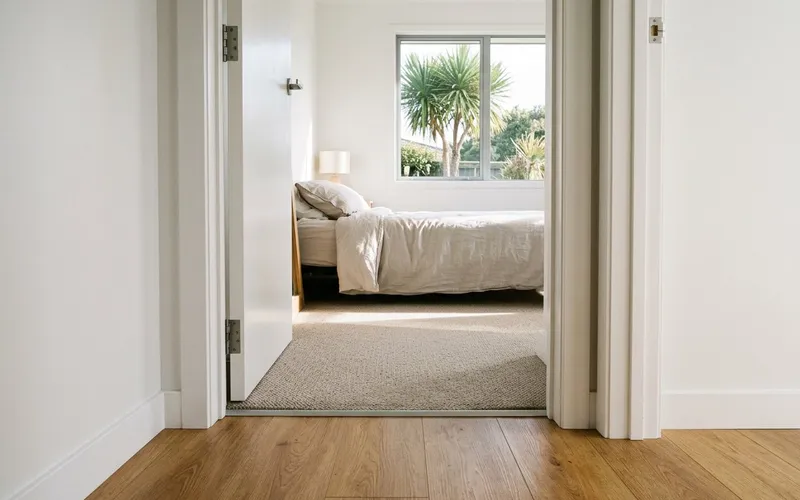
Most New Zealand homes end up with several types of flooring: carpet in the bedrooms; hybrid, vinyl or engineered timber in the living areas; and tiles or welded sheet vinyl in the bathroom and laundry. No one floor is best for a whole NZ house. In our view, picking a floor room by room beats laying one floor right through.
Prices in this guide are supplied and installed (materials and labour), so they look higher than the “from $X” figures in flooring ads, but they’re much closer to what you’ll pay. The guide covers the main floors you’re likely to be offered, from carpet and “lino” (in NZ, usually sheet vinyl) to cork and polished concrete. It doesn’t cover less common floors such as natural stone, resin, terrazzo or rubber.
Want a quick answer for each room? Jump to which floor for which room.
Our NZ flooring cost guide has the full price table, what a quote should include and where the extras hide. If you’re choosing between carpet, vinyl and hybrid, our comparison of carpet, vinyl and hybrid for NZ homes covers durability, water resistance and comfort.
Types of flooring in NZ at a glance
| Floor | Installed per m² (mid-range) | Best suited to (our view) | Main trade-off |
|---|---|---|---|
| Synthetic carpet | $50–$80 | Bedrooms, lounges, stairs | Holds stains; not for wet rooms |
| Wool / wool-blend carpet | $80–$130 | Bedrooms, formal lounges | Dearer; less spill-resistant |
| Sheet vinyl (NZ “lino”) | $35–$70 | Laundries, bathrooms (welded joints), rentals | Needs a very smooth subfloor |
| Vinyl plank (LVP) | $60–$100 | Kitchens, hallways, living areas | Joints aren’t waterproof |
| Hybrid / SPC | $80–$120 | Living areas, kitchens, rentals | Dearer than vinyl plank |
| Laminate | $55–$80 | Bedrooms, living areas, dry rooms | Swells if soaked |
| Engineered timber | $120–$250 | Living areas, over slabs | Dear; thin wear layers limit sanding |
| Solid timber (hardwood) | $150–$300 | Villas, restoration, character rooms | Moves with humidity |
| Floor tiles | about $75–$140 (large format up to about $180) | Bathrooms, laundries, entries | Cold and hard; prep is extra |
| Polished concrete | about $80–$130 + GST (existing slab) | Slab houses, modern interiors | Needs a sound slab; shows cracks |
| Bamboo | about $60–$110 | Dry living areas | Thin evidence; check the product |
| Cork | no reliable NZ installed price | Bedrooms, studies | Check wet-area use |
All prices are mid-range, per m², supplied and installed (labour and materials), from published NZ retailer, installer and cost-guide pricing checked on 3 November 2026. Premium prices are in each section below. GST treatment varies by source. Our all-floors price table has the extras. True linoleum isn’t listed: we found no NZ installed price for it (see is lino the same as vinyl?).
Two terms come up constantly. The subfloor is whatever your new floor sits on, usually a concrete slab or a timber floor on joists. A floating floor clicks together and rests on the subfloor without being glued or nailed down.
Which floor for which room
Here are our defaults for a typical NZ house. Where they overlap with our comparison guide, they match it. Your house may well change them.
| Room or house | In our view | Why |
|---|---|---|
| Bedrooms | Carpet, wool if the budget allows | Warm, soft and quiet |
| Living areas | Hybrid or engineered timber; vinyl plank to save money | Hard-wearing and easy to clean |
| Kitchens | Hybrid or quality vinyl (sealed, maker-approved), or tiles | Copes with spills and water by the sink |
| Bathrooms and toilets | Tiles over a waterproof membrane, or welded sheet vinyl | Keeps water out of the subfloor |
| Hallways | Match the adjoining space | One floor flowing through looks better |
| Laundries | Tiles, sheet vinyl, or hybrid with the maker’s wet-area documentation | Keeps leaks and splashes out of the subfloor |
| Stairs | Carpet | Soft and quiet underfoot |
| Kids, pets and rentals | Hybrid through the dry rooms; tiles or welded sheet vinyl in the bathroom | Easy to keep clean, including between tenants |
| Tight budget | Synthetic carpet in bedrooms; vinyl plank or laminate in living areas; welded sheet vinyl in wet rooms | The lowest installed prices in the table above |
| Slab houses | Engineered timber, hybrid, tiles or polished concrete | All suit a concrete base |
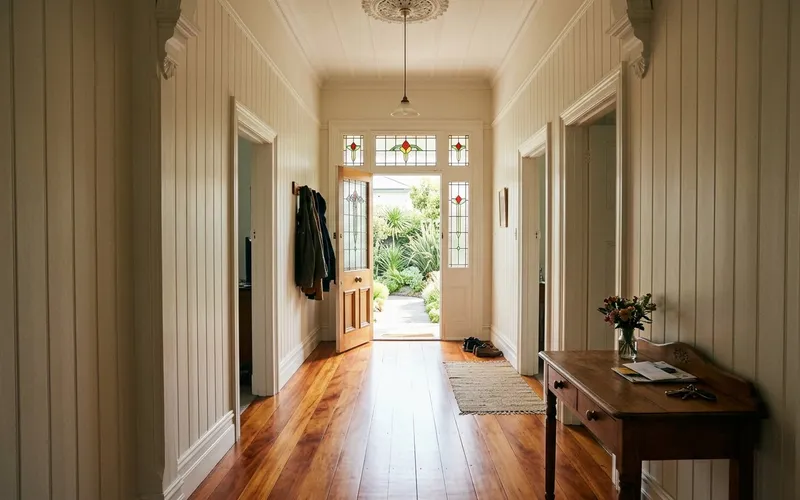
| Villas | Restore the native boards if they’re sound | Solid boards can be sanded and refinished many times |
Five things that decide which floor suits your house
Get these straight before you look at a single sample.
- The room. Wet or dry? Bathrooms, toilets and laundries need a floor that keeps water out of the subfloor. Under the Building Code’s E3 rules (the clause on internal moisture), the standard answers are tiles over a waterproof membrane, or sheet vinyl with welded or sealed joints. Dry rooms? Almost anything goes.
- What’s underneath. A concrete slab and a timber subfloor suit different floors. Engineered timber can be glued straight to a slab, and polished concrete only exists where there’s a slab to polish. Whatever you choose, hard floors want a flat base, and sheet vinyl wants a very smooth one.
- Warmth and heating. Tiles and polished concrete feel cold without underfloor heating. If you’re putting heating in, the floor has to suit it (see floors and underfloor heating below).
- Who lives there. Kids, pets and tenants change the answer. Mostly it comes down to how easy a floor is to clean, and how much you’ll mind a scratch or a stain.
- The budget. Compare installed prices, not “from” prices. For a typical 100 m² house, all in, flooring comes to roughly NZ$5,000 to $45,000+, depending on what you choose.
Carpet
Carpet is a textile floor: fibres tufted into a backing, laid over underlay (the cushioned layer underneath). It’s still the usual NZ choice for bedrooms. The fibre is the biggest factor in the price, and in how the carpet behaves.
Synthetic carpet (nylon, polyester, polypropylene)
Synthetic carpet makes up most of what’s sold here. One carpet maker’s fibre guide splits it three ways:
- Solution-dyed nylon: the colour is locked into the fibre, so it resists stains and fading. It’s also crush-resistant. The maker suggests it for hallways, stairs and family rooms.
- Polyester (including PET): soft and affordable, but less crush-resistant. Better for low- to medium-traffic rooms.
- Polypropylene: cheap and resists moisture, but flattens quickly under heavy use. Suits rentals and quiet rooms.
Suits: bedrooms, lounges and stairs.
Watch out for: wet rooms. No carpet belongs in a bathroom or laundry. Carpet also holds stains and dust-mite allergen in a way hard floors don’t.
Price: $50–$80/m² mid-range, $75–$110+ premium. Synthetic carpet is the cheapest floor most people lay through a house, though standard sheet vinyl can come in lower.
Carpet tiles are modular squares: if one gets stained, you lift it and clean or replace it. We found no reliable NZ installed price for carpet tiles.
For underlay, stairs and removal, see our carpet installation cost guide.
Wool and wool-blend carpet
Wool is the smaller, dearer end of the market. In a February 2026 submission to the Commerce Commission, one industry party estimated wool at about 25–30% of the total carpet market.
The same maker’s guide describes wool as warm and soft, able to absorb and release moisture, and “naturally stain-resistant”. It also says wool is less spill-resistant than some synthetics and can fade in prolonged direct sunlight. Wool blends mix wool with a synthetic fibre for durability. “Wool-rich” means at least 80% wool, according to Consumer NZ.
Suits: bedrooms and formal lounges.
Watch out for: the price, obviously. Spills too, and big sunny windows.
Price: $80–$130/m² mid-range, $120–$200+ premium. Premium wool is among the dearest carpets you can buy, but the bands overlap: premium nylon can cost as much as a wool blend.
Our carpet guide compares wool with synthetic and sets out what the extra money buys with wool.
Sheet vinyl (and what New Zealanders call lino)
Sheet vinyl is continuous roll flooring, usually 2–4 m wide, laid in one or two pieces, so a small room often has no joints at all. It’s the traditional floor for kitchens, bathrooms and laundries. With welded or sealed joints, it’s one of the two standard wet-area answers under E3/AS1 (the Acceptable Solution, a pre-approved way of meeting the moisture rules).
Suits: laundries, bathrooms (with welded joints) and rentals.
Watch out for: one supplier, Ecodure, says it needs “a very smooth, well-prepared subfloor”.
Price: $35–$70/m² mid-range for standard residential sheet vinyl, supplied and installed.
Is lino the same as vinyl?
In NZ, “lino” usually means sheet vinyl; true linoleum is a different, natural product. A quote or listing that says lino is probably talking about sheet vinyl.
So skip the word lino when you ask for a quote. Ask for “sheet vinyl, supplied and laid, with welded seams and sealed or coved edges if it’s a wet area”. With welded seams, the joins between sheets are sealed into one continuous surface, so water can’t get through them. A coved edge carries the vinyl up the base of the wall instead of stopping at the floor’s edge.
True linoleum is another thing entirely. One maker, Forbo, says it’s made from natural raw materials: linseed oil, limestone, wood flour, pine rosin, pigment and jute. Forbo’s Marmoleum range is PVC-free. We found no NZ installed price for true linoleum, so ask suppliers for a supply-and-lay quote if you want it.
Old vinyl and asbestos. WorkSafe says buildings built before 1 January 2000 probably contain asbestos, and lists vinyl flooring among the common places it turns up. Asbestos paper backing on old sheet vinyl and lino is friable (it can crumble to dust), and friable asbestos needs a Class A licensed removalist. So don’t lift, sand or scrape pre-2000 sheet vinyl or lino until it’s been tested. Lifting old vinyl is covered in our guide to health and safety on flooring jobs.
Prep, underlay, trims and worked examples are in our vinyl and hybrid installation cost guide.
Vinyl plank (LVP and LVT)
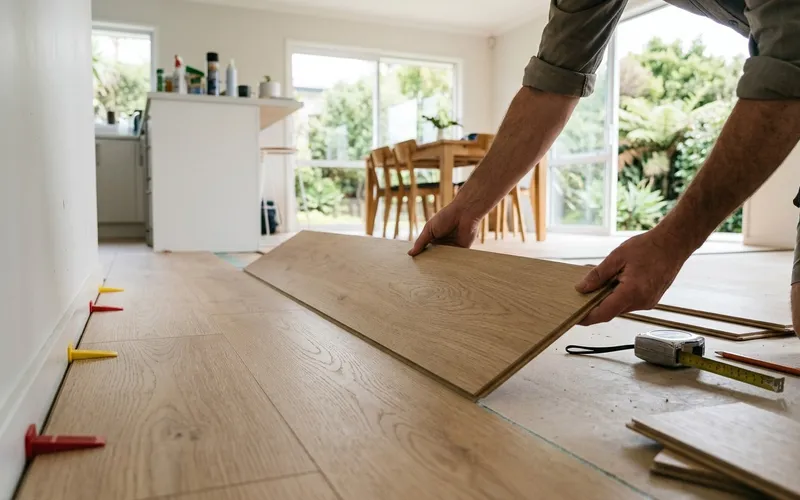
Vinyl plank is a printed design layer under a clear wear layer (the protective top coat), on a flexible PVC core. LVP stands for luxury vinyl plank. LVT, luxury vinyl tile, is the same idea cut into tile shapes. Either kind can be laid as a click-lock floating floor or glued to the subfloor.
Suits: kitchens, hallways and living areas.
Watch out for: the surface is water-resistant, but the click joints aren’t watertight, so standing water can work its way through them to the subfloor. Tradie Tools says sheet vinyl or tile is preferred over planks for shower floors. In our view that rules vinyl plank out of bathrooms. E3’s impervious, easy-clean floor rule covers kitchens, so ask for a product with an E3 compliance statement there.
Price: $60–$100/m² mid-range, $100–$140 premium.
How long vinyl plank lasts depends mostly on the wear layer, and our comparison of carpet, vinyl and hybrid sets out what thickness to look for.
Hybrid flooring (SPC)
Hybrid flooring is a rigid-core vinyl plank. The core is usually SPC (stone plastic composite), a mix of limestone and PVC that makes the plank stiff instead of bendy. In NZ listings, “hybrid” and “SPC” usually mean the same product. Some products sold as hybrid use a different core, WPC (wood-plastic composite), according to one supplier’s vinyl guide, so read the specification rather than the label.
It’s a floating click-lock floor, usually with an underlay attached. Because it floats, it needs a gap around the edges so it can expand and contract.
Is hybrid flooring waterproof? Makers say the core is. The joints and edges aren’t, and that’s where trouble starts. In our view, treat “100% waterproof” on a box as marketing until you’ve read the maker’s wet-area conditions.
Suits: living areas, kitchens and rentals.
Watch out for: it costs more than vinyl plank, it won’t forgive a bumpy subfloor, and it can’t do without those expansion gaps.
Price: $80–$120/m² mid-range, $130–$180 premium. Hybrid usually costs a little more than vinyl plank.
What’s inside an SPC plank, layer by layer, and how it copes with water at the joints, is covered in SPC flooring explained.
Laminate
Laminate has four layers: a protective melamine wear layer (a hard resin), a printed decorative layer, a core of MDF or HDF (medium- or high-density fibreboard) and a stabilising backing. It’s a floating click-lock floor.
So what’s the difference between vinyl plank, hybrid and laminate? Mainly the core. Vinyl plank has a flexible PVC core, hybrid a rigid one (usually limestone and PVC), and laminate a board made of wood fibre. Wood fibre swells when it gets soaked.
Can laminate go in a kitchen or bathroom? Laminate is water-resistant, not waterproof, and one NZ supplier calls “waterproof laminate” a marketing term. Sources differ on wet rooms. In our view, laminate doesn’t belong in a bathroom. In a kitchen, only with careful spill management and the maker’s approval.
Suits: bedrooms, living areas and other dry rooms.
Watch out for: water, and a wear rating that’s too low for busy hallways.
Price: $55–$80/m² mid-range, $80–$110 premium.
Broadly, laminate’s trade-offs sit between those of vinyl and engineered timber. For the full head-to-head, see laminate vs hybrid: which suits your house.
Engineered timber
Is engineered timber real wood? Yes. You get a real hardwood surface layer, commonly 2–6 mm thick, bonded to a plywood or HDF core. That top layer (sometimes called the veneer or wear layer) is what you see and walk on. The layered core makes it more stable than solid timber in NZ humidity. It can be glued down over a slab or floated, and it can go over underfloor heating.
Can it be sanded? Depends on the wear layer. Ask for its thickness in millimetres. Tradie Tools says a wear layer of 3–4 mm or more can typically be sanded 1–2 times, and one under 2 mm can’t be sanded. One supplier says a 20 mm board with a 6 mm oak layer can be sanded and refinished four or five times, and that cheaper boards commonly have about 2 mm of oak.
Solid or engineered for NZ conditions? In our view, engineered is the safer choice for most NZ houses, especially on a slab or with underfloor heating. Solid timber makes most sense where you’re restoring or matching existing boards.
Suits: living areas, especially over slabs.
Watch out for: the price, and thin wear layers on cheaper boards. Not a bathroom floor.
Price: $120–$250/m² mid-range, $250–$450+ premium.
Engineered timber is also sold in herringbone and chevron patterns (see herringbone and chevron).
Solid timber (hardwood), including rimu, mataī and other NZ natives
In solid timber flooring, each board is milled from one piece of wood. It’s what most people mean by hardwood or wooden flooring. Its big strength: it can be sanded and refinished many times. Its weakness is movement: it swells and shrinks with humidity, so it needs acclimatising (leaving the boards in the house to adjust) before it’s laid in NZ’s humid climate. It’s generally not for underfloor heating, because of the risk of cupping (boards curling up at the edges).
Imported hardwoods, including European oak, are sold as solid boards in NZ alongside the natives. Weighing solid against engineered? See our view on engineered timber above.
Suits: villas, restorations and character rooms.
Watch out for: movement with humidity, underfloor heating, and a longer install than other floors.
Price: $150–$300/m² mid-range, $300–$500+ premium (including reclaimed native).
Reclaimed native timber (rimu, mataī, tawa, kauri)
Can you still get rimu, mataī or kauri flooring? Yes. Some new native timber is milled under MPI approval, but in our view most of what’s sold is reclaimed or salvaged.
One reclaimed-timber merchant describes the main species like this:
- Rimu: varies “from light to dark reddish brown”. The merchant says “historically, rimu flooring is the most common floor in NZ houses”.
- Mataī: deep red. Recycled mataī can be in short supply, so that merchant supplements it with new mataī milled from salvaged logs.
- Tawa: whitish.
- Kauri: golden, and “traditionally found in pre-1920 houses”.
Most Auckland villas were built with tongue-and-groove kauri, rimu or mataī boards. If you own a villa, our guide to the best flooring for Auckland villas covers restoring native boards and subfloor moisture.
Tiles
Floor tiles are mostly ceramic or porcelain. Porcelain is denser than ceramic, less porous, and more resistant to moisture and scratching. Laid over a waterproof membrane, tiles are one of the standard answers for wet rooms under E3/AS1.
They’re hard. They also feel cold underfoot without underfloor heating, because tile has very low thermal resistance (heat passes through it easily). With underfloor heating, though, tile works well.
Suits: bathrooms, laundries and entries.
Watch out for: cold feet without heating, and extras such as waterproofing and floor prep.
Price: about $75–$140/m² supplied and laid for standard-format floor tiles, and up to about $180 for large format, excluding waterproofing and floor prep. A whole bathroom floor with waterproofing costs more, about $160–$300/m². These tile figures don’t come from our main cost guide, so treat them as approximate.
Bathroom tiling in older houses is covered in our Auckland villa flooring guide.
Polished concrete
Polished concrete isn’t a covering you lay. The existing slab is ground and polished, so it only works where there’s a sound concrete slab to start with.
Suits: slab houses and modern interiors.
Watch out for: you get the slab you’ve got.
- Colour and stones show. One Auckland contractor’s guide says the finish “shows whatever the concrete does, including colour variation and the pattern of aggregate exposure” (the stones in the mix).
- Cracks. The same guide quotes the industry code of practice: “It is not possible to guarantee the absence of concrete cracking”.
- Old marks and patches. Another Auckland contractor says tile ghosting (marks left where old tiles sat) is a characteristic of the slab, and that the slab won’t polish over self-levelling compound (a pourable filler used to flatten a floor).
- Curing time. The same contractor says a new slab should cure for at least 28 days before grinding.
- Cold. Like tile, polished concrete is hard, and its low thermal resistance means it feels cold without heating.
Slab under your carpet? It might polish up well. You won’t really know until the carpet’s lifted and a contractor has done a test grind, because that’s when the problems flagged above come to light: old tile marks, patches of self-levelling compound and cracks.
Price: about $80–$130/m² + GST on an existing slab, from one Auckland contractor’s published figures. Small jobs cost more per m².
Ask for a site visit before a quote. Our questions to ask an installer on the first call apply here too.
Cork
Cork’s a natural floor, and comfortable underfoot. Resene’s Habitat guide says cork tiles are insulating, and a cork supplier quoted there says they’re quieter than most floors and hold heat well. It comes as glue-down tiles or planks, or as floating planks.
Suits: bedrooms and studies.
Watch out for: wet areas. Thinking about cork in a kitchen, laundry or bathroom? Check with the maker first.
Price: we could not find a reliable NZ installed price. The only figure we found is supply only: one NZ importer lists 6 mm glue-down cork at $124–$140/m² RRP including GST, before freight or laying.
Ask for supply-and-lay quotes. Our guide to what’s actually in a flooring quote shows what each one should list.
Bamboo
Bamboo flooring comes as planks, including strand-woven and click-together types. It’s niche here.
Suits: dry living areas.
Watch out for: claims you can’t check. We found no independent NZ source on bamboo’s hardness or durability, so go by the specific product’s documentation and warranty rather than general claims about bamboo.
Price: about $60–$110/m² supplied and installed, but the sources don’t all price it on the same basis (see the bamboo sources at the end).
Before you commit, ask for supply-and-lay quotes and vet whoever will lay it.
Herringbone and chevron: a pattern, not a floor type
Herringbone and chevron are layouts, not materials. In herringbone, rectangular blocks meet end to side in a zigzag. In chevron, the ends are cut at an angle so they meet at a point. NZ listings offer both in engineered timber, laminate and hybrid, and tile can be laid the same way. Parquet is the broader name for timber laid in small blocks or patterns.
What the pattern changes is mostly the labour. One supplier says herringbone timber is priced the same per m² as plank, but installation “can run up to double the plank rate”, and it needs more spare material.
Price: use the engineered timber bands above for the product, and expect a pattern to cost more to lay than straight planks.
Floors and underfloor heating
Underfloor heating “cannot heat a room quickly and is most effective when left on all the time over the cooler months”, according to the government’s Building Performance site. It also says carpeting over a heated floor traps heat.
Some floor finishes let heat through more easily than others. Tiles and polished concrete are the easiest. Engineered timber and most LVT and rigid-core vinyl can go over underfloor heating, but solid timber generally isn’t suited to it. Beyond that, sources disagree. One maker’s NZ hybrid instructions rule out electric radiant heating, for instance, so always check the maker’s instructions for your type of heating. Our guides go further on SPC over underfloor heating and laminate and hybrid over underfloor heating.
Which floors feel warmest and coldest? Without heating, tiles and polished concrete feel coldest. At the warmer end, cork is described as insulating and quiet. Carpet’s warmth and sound absorption are covered in our comparison guide.
Frequently asked questions
What is hybrid flooring?
A rigid-core vinyl plank that clicks together as a floating floor, usually with underlay attached. The core is usually SPC (stone plastic composite), a limestone and PVC mix, but some products use other cores, so check the spec.
Is hybrid flooring waterproof?
Makers say the core is, but the joints and edges are the weak point. Some hybrids carry E3 compliance statements for wet areas, but not all do, so read the maker’s wet-area conditions before trusting a “waterproof” label.
Can laminate go in a bathroom?
Not in our view: its fibreboard core swells if it gets soaked, and makers and retailers differ on wet rooms. For bathrooms, tiles over a membrane or welded sheet vinyl are the standard answers.
Which flooring works with underfloor heating?
Heat passes most easily through tiles and polished concrete. Engineered timber and most LVT and rigid-core vinyl can go over it too, but solid timber generally isn’t suited to it. Check the maker’s instructions for your type of heating.
Does lino mean vinyl?
Usually. In NZ, “lino” on a quote is probably sheet vinyl. True linoleum is a different product, made from natural materials such as linseed oil and jute.
What to do next
- Price your floor. Use our NZ flooring cost guide for 2026 to budget the floors you’re considering, extras included.
- Compare the big three: carpet, vinyl and hybrid. If your shortlist includes any of them, read our honest comparison of carpet, vinyl and hybrid before you visit a showroom.
- Get ready before you call anyone. Measure each room. Find out what your subfloor is (concrete slab or timber). Shortlist two floors per room. Then get three quotes, using our checklist to vet a flooring installer.
Methodology and sources
Checked 3 Nov 202636 sources
Ranges compiled from published NZ retailer, installer and cost-guide pricing, checked on 3 November 2026. Sources are listed below.
Underfoot has not collected installer quotes or run its own product tests.
Prices for tiles, polished concrete and bamboo come from separate sources listed below; GST treatment differs between sources. The carpet, vinyl, laminate and timber bands are the same as in our cost guides. For cork, true linoleum and carpet tiles we found no reliable NZ installed price. The note on what “lino” means in NZ comes from NZ flooring sources that use “lino” for sheet vinyl (listed below). Anything marked “in our view” is Underfoot’s judgement.
Prices (16)
- Tradie Tools: carpet cost NZ
- Tradie Tools: vinyl flooring cost NZ (GST inclusive, updated June 2026)
- Tradie Tools: timber flooring cost NZ (includes bamboo, GST inclusive, updated June 2026)
- Tradie Tools: tiling cost NZ (GST inclusive, updated June 2026)
- Tradie Tools: tiler pricing guide NZ 2026 (GST not stated, updated May 2026)
- Tradie Tools: bathroom tiling cost NZ (via our villas guide)
- Insta Quotes: tiling quote template NZ (via our villas guide)
- Tradie Tools: carpet and flooring calculator
- Superior Property Services: cost of carpet laying and installation
- Marchand: engineered oak flooring cost NZ (excludes GST, reviewed October 2026)
- Ecodure: guide to flooring types in New Zealand
- Auckland Concrete Driveways: concrete floor cost NZ (excludes GST)
- Diamond Shine Concrete: grinding and polishing (excludes GST)
- Trade Flooring: bamboo flooring (excludes GST)
- Floortech: bamboo flooring (includes GST, product price)
- QCG: Cork Pure (RRP including GST, supply only)
Products and behaviour (15)
- Godfrey Hirst: carpet fibre types explained
- Consumer NZ: carpet
- Cowes Bay Group: cross-submission to the Commerce Commission (PDF, February 2026)
- Ecodure: vinyl flooring guide
- Architecture Now: walk on by (flooring focus)
- KR Flooring: types of vinyl
- BRANZ Level: quick reference guide for wet-area floor finishes
- Godfrey Hirst: hybrid installation instructions (PDF)
- Bunnings NZ: how to choose the right type of flooring
- Forbo: Marmoleum FAQ
- Forbo: Marmoleum Modular tiles
- Freedom Flooring: solid timber flooring
- Kauri Warehouse: flooring
- Resene Habitat: a beginner’s guide to flooring
- KE KELIT: underfloor heating with screed (PDF)
Rules and government (5)
Once you’ve picked your floors, our step-by-step guide to a flooring installation covers lead times, subfloor checks and what happens on the day.